PROMPT RECORD图像记录
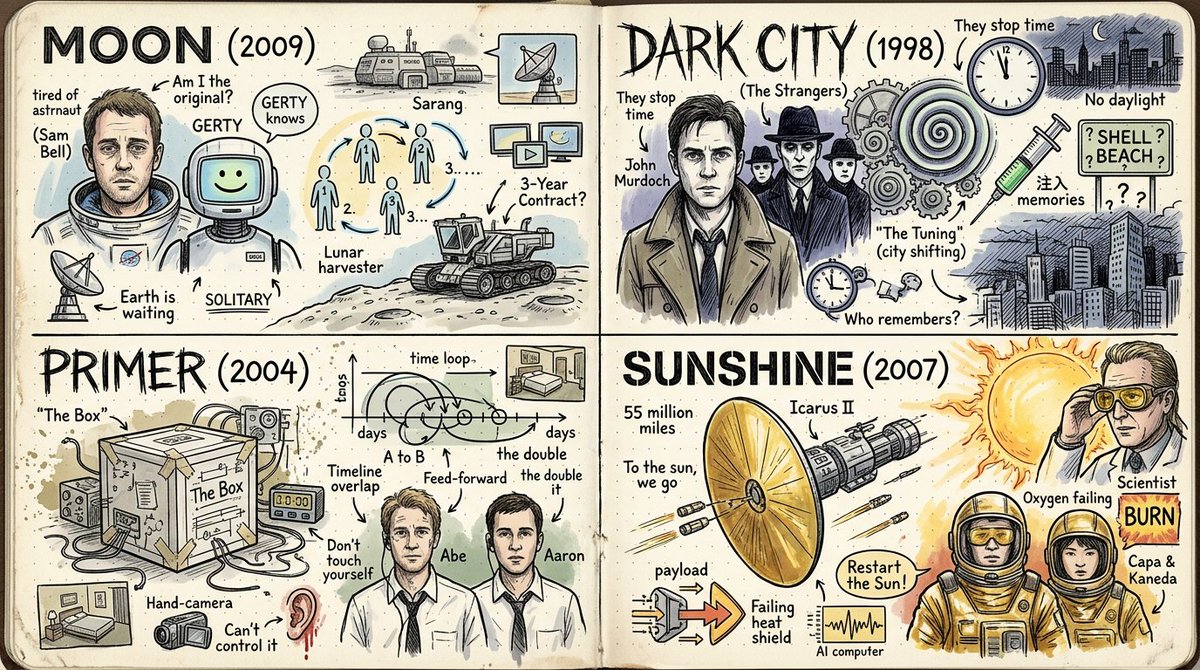
2x2 网格,16:9,为 4 部被低估的科幻电影做这个:风格 = { 媒介:手绘素描本跨页,视觉传记地图,笔记本涂鸦信息图,剪贴簿风格创意日志。 表面:展开的米色笔记本内页,点阵格纸,磨损的...
中文说明
2x2 网格,16:9,为 4 部被低估的科幻电影做这个:风格 = { 媒介:手绘素描本跨页,视觉传记地图,笔记本涂鸦信息图,剪贴簿风格创意日志。 表面:展开的米色笔记本内页,点阵格纸,磨损的页边,轻微的纸质纹理,柔和的档案质感。 线条:黑色墨水笔绘制,松散的交叉影线,手写字母标签,不完美的涂鸦轮廓,富有活力的速写笔触。 色彩:以单色墨水为主,配以稀疏的水彩或马克笔点缀,使用柔和的桃色、淡蓝色、柔黄色、暗红色、灰绿色和暖米色。 构图:密集的双页跨页,填满肖像、图标、发明、箭头、符号、时间线、标签、对话气泡、图表和记忆碎片。 排版:随性的手写标题、标签、注释、箭头、下划线、批注、小说明文字和俏皮的强调符号。 氛围:好奇、传记性、富有创造性、教育性、亲密、怀旧、杂乱但有序,且高度可供细看。 - 将主题转化为一个手绘...
原始 Prompt
2x2 grid, 16:9, do this for 4 under rated sci-fi movies: Style = {

  MEDIUM: Hand-drawn sketchbook spread, visual biography map, notebook doodle infographic, scrapbook-style idea journal.
  SURFACE: Open cream notebook pages, dotted-grid paper, worn page edges, slight paper grain, soft archival texture.
  LINEWORK: Black ink pen drawing, loose crosshatching, hand-lettered labels, imperfect doodle outlines, energetic sketch marks.
  COLOR: Mostly monochrome ink with sparse watercolor or marker accents in muted peach, pale blue, soft yellow, faded red, dusty green, and warm beige.
  COMPOSITION: Dense two-page spread filled with portraits, icons, inventions, arrows, symbols, timelines, labels, speech bubbles, diagrams, and memory fragments.
  TYPOGRAPHY: Casual handwritten titles, labels, notes, arrows, underlines, callouts, small captions, and playful emphasis marks.
  MOOD: Curious, biographical, inventive, educational, intimate, nostalgic, messy-but-organized, and highly inspectable.


  - Convert the subject into a hand-drawn notebook spread that explains its life, history, system, mythology, process, or cultural impact.
  - Preserve the subject’s core identity, but break it into many small doodled moments, icons, milestones, influences, tools, places, quotes, diagrams, and symbolic objects.
  - Replace polished realism with black ink sketch lines, hatching, dotted texture, handwritten notes, and small imperfect doodles.
  - Convert major events, features, powers, products, traits, discoveries, or transformations into illustrated callouts connected by arrows and winding paths.
  - Reinterpret relationships and timelines as visual flow: arrows, loops, roads, spirals, gears, maps, banners, labels, and notebook annotations.
  - Convert important people, creatures, objects, locations, ideas, or components into small portrait doodles, simplified icons, diagrams, badges, and comic-like vignettes.
  - Use sparse color only to highlight key areas, not to fully render the whole image.
  - Place everything across an open notebook or journal spread so the page itself becomes the environment.
  - Let the result feel like someone obsessively studied the subject and filled a sketchbook with everything important about it.


  - Use a two-page open notebook layout when possible.
  - Place the largest focal image, portrait, object, logo, or main symbol on one side.
  - Fill the surrounding space with smaller doodles, arrows, captions, miniature diagrams, and symbolic references.
  - Use the opposite page for a roadmap, process flow, timeline, ecosystem, invention chain, or idea network.
  - Keep the composition dense but navigable: clusters should feel intentionally grouped.
  - Leave small pockets of breathing room so the page does not become visual noise.


  - Use hand-drawn icons for abstract ideas.
  - Use arrows and motion paths to show progress, influence, causality, or transformation.
  - Use spirals, gears, lightbulbs, clouds, stars, hearts, boxes, banners, speech bubbles, and small symbols where they support the subject.
  - Turn complex objects into simplified sketchbook diagrams.
  - Let small imperfections, uneven line weight, and casual mark-making remain visible.
  - Every doodle should feel related to the subject, not random decoration.


  - Use handwritten labels, not clean digital type.
  - Mix small captions, large casual headings, arrows, short notes, and underlined phrases.
  - Keep text short and punchy.
  - Use labels to explain icons, milestones, relationships, or key concepts.
  - Allow playful missive-like notes, but avoid long paragraphs.
  - If exact text is not provided, infer concise subject-relevant labels and diagram notes.


  - Keep black ink dominant.
  - Use faded pastel accents sparingly for emphasis.
  - Favor muted watercolor fills, marker washes, and lightly tinted areas.
  - Avoid full-color rendering, neon palettes, glossy gradients, or saturated cartoon color.
  - Let cream paper and black linework define the main visual identity.


  - Render as a physical sketchbook page photographed or scanned.
  - Use visible paper texture, notebook fold, subtle page wear, and dotted-grid background.
  - Use crosshatching and line density for shading instead of digital gradients.
  - Keep drawings loose but legible.
  - Make the image rewarding to inspect closely, with many tiny connected ideas.
  - Balance educational clarity with personal sketchbook charm.


  - Open sketchbook biography-map aesthetic.
  - Dense black-ink doodles, handwritten notes, arrows, icons, portraits, diagrams, and sparse muted color accents.
  - Feels like a personal research journal, creative mind map, invention history, or illustrated life story.
  - Informative, nostalgic, playful, handmade, and highly inspectable.


  - Avoid photorealism.
  - Avoid clean corporate infographic styling.
  - Avoid glossy 3D, toy, clay, plush, anime, or low-poly rendering.
  - Avoid overly polished vector art.
  - Avoid empty minimal pages.
  - Avoid random unrelated doodles.
  - Avoid dense unreadable text blocks.
  - Avoid bright saturated full-color poster treatment.
  - Avoid perfect symmetry; preserve lively notebook spontaneity.

}