PROMPT RECORD图像记录
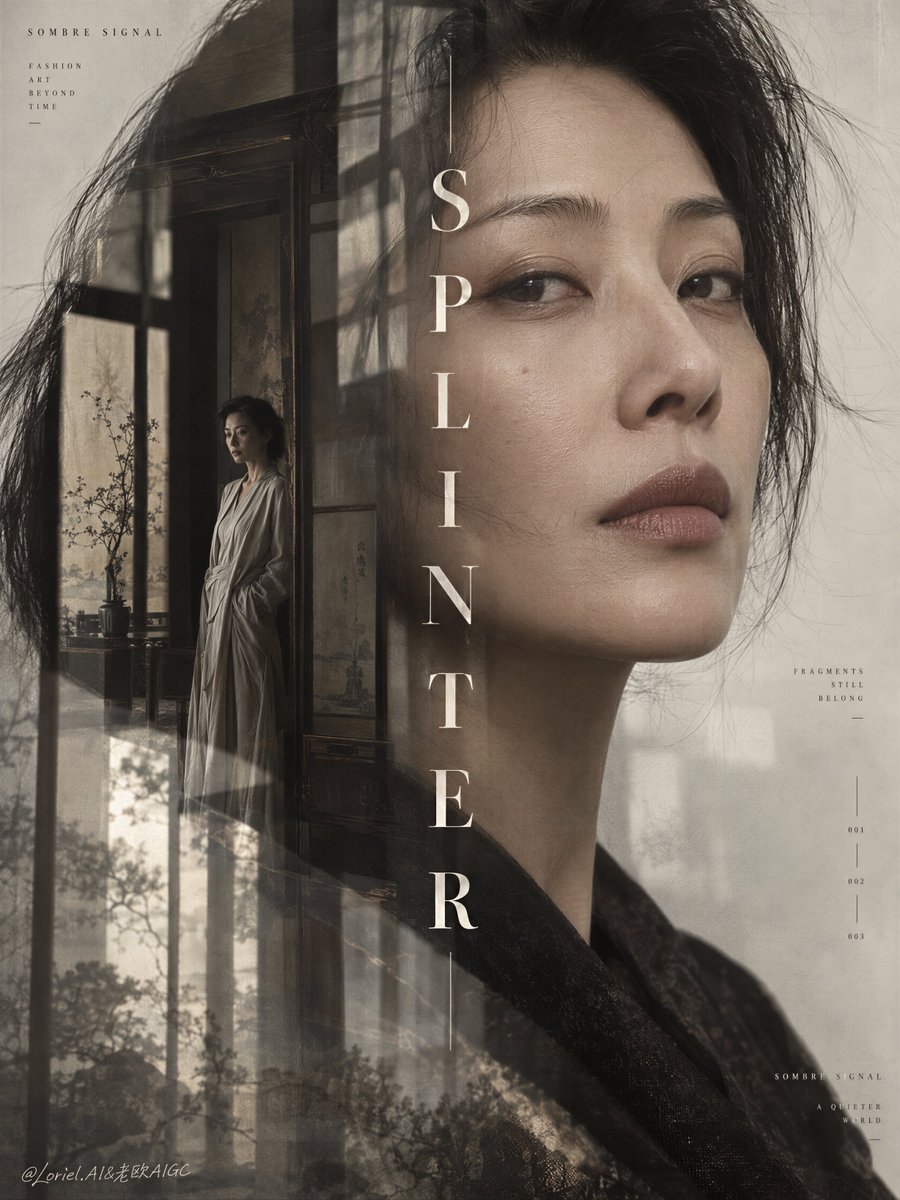
一次双重曝光需要第二个场景来承担任务。 🪽 将门框、垂直窗棂和柔和反光与肖像的额头、脸颊、脖颈与肩部平面相对齐 让建筑结构嵌入面部之中,而非像拼贴一样浮于其上。 ✨ 在室内靠近门的位置放置一个...
中文说明
一次双重曝光需要第二个场景来承担任务。 🪽 将门框、垂直窗棂和柔和反光与肖像的额头、脸颊、脖颈与肩部平面相对齐 让建筑结构嵌入面部之中,而非像拼贴一样浮于其上。 ✨ 在室内靠近门的位置放置一个更小的、远景的人物,让她部分被肖像图层吸收 这个人物为画面提供了一个内在视角。混合因此成为记忆或思绪——而不只是纹理。 GPT- image 2.5 prompt👇 为虚构的国际时尚艺术品牌 SOMBRE SIGNAL 创作一张博物馆级概念编辑海报,设计为单张竖构图的印刷图像,将一幅主导的女性肖像、一个嵌入的室内人物,以及一个极度克制的字体系统融合为一个充满心理张力的视觉场域。最终构图需让人感受到 Orbit、Transit 与 Port 三者的交汇:情感更深、材质更锐利、策展化更精简。它应同时读作戛纳级别的艺术时尚主视觉...
原始 Prompt
A double exposure needs a second scene with a job.
🪽 align doorway frames, vertical window bars, and soft reflections with the portrait’s forehead, cheek, neck, and shoulder planes
The architecture feels embedded in the face instead of floating over it like a collage.
✨ place one smaller, distant figure inside the interior near a doorway, partly absorbed by the portrait layers
That figure gives the image an inner point of view. The blend becomes memory or thought—not just texture.

GPT- image 2.5 prompt👇
Create a museum-grade conceptual editorial poster for a fictional international fashion-art brand named SOMBRE SIGNAL, designed as a single vertically composed print image that fuses one dominant female portrait, one embedded interior figure, and a severely restrained typographic system into one psychologically charged visual field. The final composition must feel like the convergence of Orbit, Transit, and Port: emotionally deeper, materially sharper, and more curatorially reduced. It should read as a Cannes-level art-fashion key visual, a collectible gallery poster, and a luxury independent magazine cover at once.

The core image is a large close portrait of a mature East Asian woman occupying most of the poster. She is calm, distant, and emotionally unreadable, with a quiet but magnetic gaze directed slightly past camera. Her face must feel real and intimate: correct eye spacing, refined nose bridge, soft but precise lip structure, natural jawline, believable ear placement if visible, realistic neck and shoulder transition, subtle pores, faint tonal irregularity, delicate under-eye softness, and natural hairline flyaways. Her short dark hair frames the portrait with slight looseness, helping the silhouette breathe into the pale background. No beauty-ad gloss, no plastic skin, no over-retouched perfection. The mood is restraint, memory, and internal fracture.

Inside and across the main portrait, embed a second real mature female figure standing within a dim architectural interior, as if she exists inside the mind or emotional chamber of the larger face. She wears a pale draped shirt, robe, or fluid tailoring, and stands near a doorway, partition, or old lacquered frame structure. Her scale must feel exact and elegant within the montage, partially masked by the large portrait planes. She should not look like a pasted collage element; she must feel absorbed into the visual anatomy of the main image. This embedded figure is quieter, more distant, and more spectral than before, adding inner narrative without clutter.

Push the composition toward international surreal main-visual territory by reducing literal editorial clutter. Keep only the most essential layering devices: translucent window reflections, a few vertical frame bars, soft interior partitions, and selective ghosted light bands crossing the face. These overlays should feel like architecture passing through memory, not graphic noise. Let the montage breathe. The image should feel more silent, more expensive, and more psychologically exact than a normal magazine design.

Typography must be colder, fewer, and more sculptural. Use one dominant vertical word running through the center of the face, such as "SPLINTER" or "MIRROR", broken across lines in tall refined uppercase, acting as the central graphic spine. Add only a very small number of secondary microtype elements: a tiny brand line "SOMBRE SIGNAL" near the top or side margin, one or two short offset editorial fragments, and one subtle vertical glyph run or index-like notation. No dense blocks, no paragraph copy, no visible explanatory text mass. Typography must behave like spatial interruption and printed architecture, never like information. Keep it crisp, pale, and carefully aligned to the portrait structure, avoiding the eyes and major lip contour.

Color and light hierarchy: 55% warm paper grey, muted taupe, pale stone, and editorial beige; 20% skin rose-beige and soft facial warmth; 15% dark espresso-brown, charcoal hair depth, and interior shadow; 10% chalk white typography, reflection haze, and pale luminous architectural overlay. Lighting must be quiet and directional: soft window light grazing the face, low-contrast interior depth in the embedded figure, subtle reflective streaks crossing selected areas, and smooth tonal falloff into muted shadow. The whole poster should feel like an analogue print object: gentle paper grain, faint dust, restrained filmic softness, and premium offset-print realism.

Material semantics must be explicit and elevated: skin microtexture, paper tooth, glass reflection haze, lacquered wood trim, soft fabric folds, hair strand separation, faint print abrasion, and translucent typographic layering. The image should not rely on decorative particles, glitch effects, or trendy distortion. Its power comes from silence, spatial layering, emotional precision, and reduced graphic confidence.

Rendering target: photoreal mixed-media editorial poster, luxury fashion-art realism, psychologically layered portrait montage, minimal high-design typography, premium print-finish texture, international gallery-grade sophistication, and strong negative-space discipline.

Structured exclusion constraints: no copied source text, no real person names, no oversized text clutter, no garbled letters, no random logos, no cheap glitch styling, no plastic skin, no distorted facial anatomy, no duplicated facial features, no asymmetrical eyes, no collage seams, no cyberpunk effects, no muddy beige haze, no style drift, no AI slop.