PROMPT RECORD图像记录
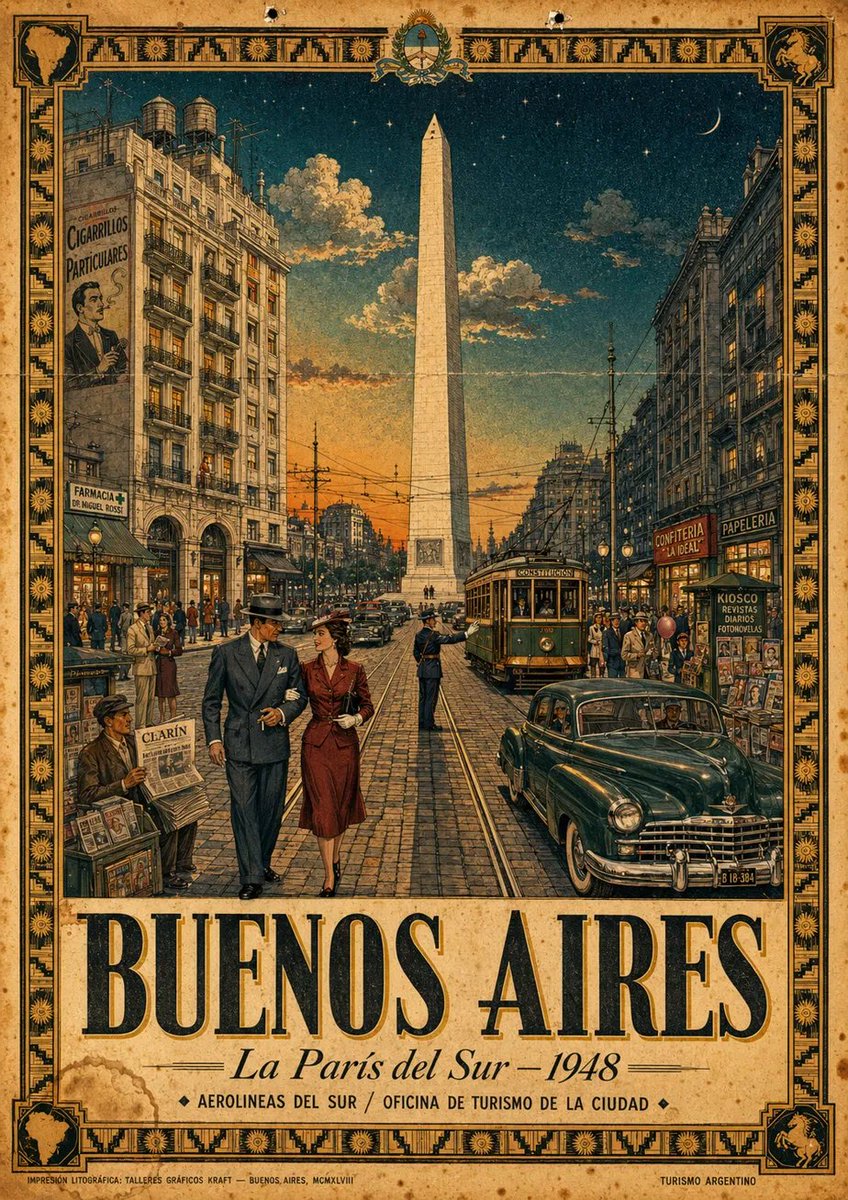
1948年的布宜诺斯艾利斯,像一张从未印刷的旅行海报。 方尖碑、有轨电车、黄昏时的9月大街。 我盯着它看了很久。 gpt image 2. prompt 👇 { "id": "buenos_a...
中文说明
1948年的布宜诺斯艾利斯,像一张从未印刷的旅行海报。 方尖碑、有轨电车、黄昏时的9月大街。 我盯着它看了很久。 gpt image 2. prompt 👇 { "id": "buenos_aires_poster_1948_ultra", "titulo": "布宜诺斯艾利斯 — 1948年复古旅行海报,极致细节", "prompt": "A hyper-detailed vintage 1940s Argentine travel poster for Buenos Aires, executed with obsessive period accuracy and micro-detail density — every square centimeter of the image contains de...
原始 Prompt
buenos aires en 1948, como un cartel de viaje que nunca se imprimió.

el obelisco, los tranvías, la 9 de julio al atardecer.
me quedé un buen rato mirándola.

gpt image 2.

prompt 👇

{
  "id": "buenos_aires_poster_1948_ultra",
  "titulo": "Buenos Aires — Cartel de Viaje Vintage 1948, Máximo Detalle",

  "prompt": "A hyper-detailed vintage 1940s Argentine travel poster for Buenos Aires, executed with obsessive period accuracy and micro-detail density — every square centimeter of the image contains deliberate information that rewards close inspection and compels the viewer to zoom in. The image is a single large-format lithographic poster illustration, approximately 70×100cm at 600dpi equivalent — the resolution of the final image must allow individual ink strokes, individual benday dots, individual letterform serifs, and individual architectural carved motifs to be legible and distinct. PRINTING PROCESS SIMULATION: The image is rendered as if produced by a master lithographer using 7 separate color plates: Plate 1 — keyline black (all ink linework and crosshatching). Plate 2 — warm amber-gold. Plate 3 — deep teal-prussian blue. Plate 4 — crimson-burgundy accent. Plate 5 — stone cream. Plate 6 — aged ochre-yellow. Plate 7 — cool grey-blue. The interaction between these plates defines every color in the image — no color is solid digital flat, every area shows the slight variation and texture of actual ink on paper. In the gradients (sky, shadow areas), the benday dot pattern is visible: varying dot sizes from 20% to 80% screen coverage, the dots slightly irregular as hand-applied screens, creating the characteristic tonal texture of 1940s lithographic print. At color transitions — where teal sky meets amber building, where amber light meets shadow — a 0.5-1mm misregistration of color plates is visible, a thin halo of one color appearing beyond the edge of the adjacent color, the inevitable imperfection of hand-registered lithographic printing. THE PAPER — THE SUBSTRATE OF EVERYTHING: The entire image sits on aged poster paper — not generic yellowing, but the specific deterioration of a 78-year-old poster that survived in a Buenos Aires archive. The paper color: warm ivory-cream (#f4edd8) at the center, deepening to warm amber-tan (#c8a560) at the four edges and corners where oxidation was more severe. The paper texture: visible paper grain — the fine wire-laid pattern of the pulp visible especially in the lighter areas of the sky. Foxing: approximately 40-50 individual foxing spots scattered asymmetrically across the poster surface — each a circle of rust-orange-brown (#8b5a2b) with a slightly darker ring and lighter center, ranging from 2mm to 8mm in diameter, concentrated near the corners and one cluster along the right edge. A horizontal fold crease runs across the poster at approximately 40% from the top — a fine compression line with slightly different light reflection and a hairline crack in the ink along the crease line. Three pin-holes in the top margin where the poster was tacked to a wall — the paper compressed and slightly torn around each. Small water stain in the lower left corner: a tideline ring of tan-brown. THE ILLUSTRATION SYSTEM — INK LINEWORK: The entire illustration is built on a foundation of ink linework rendered in Plate 1 black, with line weights ranging from 0.1mm hairlines (window frame details, leaf veins, textile patterns) to 1.5mm bold outlines (the Obelisco silhouette, border frame, title text). The linework is the skeleton onto which color plates are registered. Every architectural surface has its specific crosshatching language: STONE FACADES: parallel horizontal hatching lines at 1mm spacing, with a second layer of diagonal lines at 45° creating a fine mesh in the deeper shadows — the shadow sides of window reveals, the undersides of balcony projections, the recesses of arched doorways. COUNT OF HATCHING LINES: approximately 300-400 individual parallel hatch lines visible in each building facade at full resolution. METAL SURFACES (tram wires, ironwork, lamp posts): fine parallel vertical hatching, thinner lines, more spacing — suggesting the cool grey reflectivity of metal. SKY AREAS: no linework — pure benday dot patterns in the teal-blue plate, the dots visible as a sea of small circles in the lighter sky areas, compressing to nearly solid ink at the deep teal zenith. SHADOWS ON PAVEMENT: diagonal crosshatching at 30° and 60° creating a diamond grid pattern in the shadow areas of the avenue surface. COMPOSITION — THE PANORAMIC VIEW: The poster is in portrait format 70×100cm, but the illustration itself occupies a wide panoramic zone — the illustrated image fills from 10% (below the top border) to 82% (above the bottom text zone) of the total poster height, maintaining a horizontal emphasis within the vertical poster format. THE VIEWPOINT: The perspective is from the level of an elevated café terrace or second-story window on the south side of Corrientes, looking NORTH along Avenida 9 de Julio — one of the widest avenues in the world (140 meters across at this point) stretching in perfect rectilinear perspective toward its vanishing point in the deep teal distance. The perspective is strict one-point, the avenue's converging lines of tram tracks, paving stones, tree lines, and building façade lines all meeting at the Obelisco's base. THE OBELISCO: The Obelisco de Buenos Aires occupies the exact center of the composition, its tip reaching to 85% of the illustration's height. In the poster illustration it is rendered with precise architectural accuracy: SHAFT: a square-plan obelisk, 67.5 meters of Italian Roman travertine, tapering from approximately 7m at the base to the apex. The shaft is rendered in the stone-cream plate with careful light graduation — the west-facing face (left) in full warm amber light, the east face (right) in cool grey shadow with heavy crosshatching, the recessed chamfer lines between faces rendered as precise hairline black strokes running the full height. At full resolution: the individual horizontal joints between stone courses are visible as fine ink lines at approximately every 8mm in the illustration scale. RELIEF PANELS AT THE BASE: The four carved relief panels at the Obelisco's base (each depicting a historical Buenos Aires scene — the First Junta, the Declaration of Independence, the 1st appearance of the Buenos Aires flag, and the Federal Federalization) are rendered in miniature: each panel approximately 12×8mm in the poster but containing discernible figurative relief carving detail — draped figures, classical architectural elements, text fragments in the relief impossible to read but present as crosshatching texture suggesting carved stone. FOUNDATION BLOCKS: The base platform of the obelisco — the stepped square plinth — rendered with individual stone course lines, the plaza paving around it with radial pattern visible. At the base, in extreme miniature: two or three human figures standing at the obelisco's foot establishing absolute scale — they are 2-3mm tall in the poster but rendered with recognizable silhouette: a man in a double-breasted suit and fedora, a woman in a wide-skirted dress. THE APEX: The four triangular faces of the pyramid apex are rendered in full amber light — the tip catching the last warm light against the deep teal sky. A stylized lightning rod at the very tip, 1mm of vertical line. THE AVENUE: Avenida 9 de Julio stretches in perspective from the foreground (occupying 35% of the illustration width at the bottom) to the vanishing point at the Obelisco base. THE PAVEMENT: The foreground section of the avenue shows the actual paving material of 1948: large rectangular asphalt paving blocks (adoquines) laid in a herringbone pattern, each block individually rendered as a rectangle with a slightly lighter top face and dark hatched shadow on one edge — at the foreground closest to the viewer, each paving block is approximately 4×2mm in the poster, each individually drawn. Approximately 200-300 individual paving blocks visible in the foreground section before perspective compression eliminates individual block legibility. TRAM TRACKS: Two pairs of steel tram rails are embedded in the pavement, running in perspective toward the Obelisco — rendered as thin double-line strokes in the key plate, slightly wider than the surrounding paving lines, with a small shadow on their right sides suggesting raised metal. The rails reflect the amber sky in a specular highlight — a thin warm line along their crown. OVERHEAD TRAM WIRES: A network of overhead copper tram wires spans the avenue at approximately second-floor height — rendered as very fine hairline ink strokes (0.1mm) running horizontally across the composition, sagging gently between the wooden trolley poles (each pole a vertical 0.3mm ink stroke with cross-arm brackets). At the intersection zone near the Obelisco, the wires multiply into a geometric web of crossing lines — 15-20 individual wire strands visible, their intersections creating small white dots where they overlap. THE FLANKING BUILDINGS — LEFT SIDE (west face, in warm amber light): A continuous wall of 1940s Buenos Aires architecture runs the left side of the avenue in perspective. The closest building: a 12-story Art Deco apartment building with limestone facade. In maximum detail: the base has a rusticated stone ground floor with two arched entry portals — each arch rendered with keystone detail and fluted pilaster capitals, the arch spandrels containing carved rosette motifs (individual petal count visible). Above the ground floor: ten floors of repeated window bays. EACH WINDOW BAY: a pair of double-hung sash windows with stone surrounds, a thin stone lintel with a decorative keystone, a projecting stone sill with drip molding. The ironwork balconies: each balcony railing is a 5-6mm wide ink-rendered pattern of vertical bars and horizontal rails, with at the corner panels a stylized Argentine fan or sunburst motif in cast iron — each balcony railing contains approximately 15-20 vertical bars individually inked. Some windows: lit from within in warm amber — a slightly lighter amber patch within the window opening suggesting interior lamp light at dusk. Some balconies: inhabited — in miniature, a figure leans on a railing (3mm silhouette), a woman in a dressing robe, one hand raised to her hair. BUILDING ROOFLINE: the top floor has a decorative frieze of repeated geometric motifs (stepped pyramidal forms in Art Deco tradition), a cornice projecting with dentil molding (each dentil individually rendered), and a flat roof parapet with stone coping. On the roof: two cylindrical water towers (tanques de agua — the characteristic roof water tanks of Buenos Aires apartment buildings) in grey-blue ink, their conical roofs with ventilation caps. A radio antenna and a line of laundry barely discernible at the parapet edge. THE CLOSEST BUILDING'S SIGNAGE: A large painted wall advertisement on the side face of the first building, rendered in the style of a 1948 Argentine commercial sign: 'CIGARRILLOS PARTICULARES' in hand-lettered capitals, art deco design, partially faded as if old, with an illustration of a smoking man in a tuxedo — all rendered in ink linework with color wash. Below it, a smaller enamel sign reading 'FARMACIA — DR. MIGUEL ROSSI' with a green cross. THE FLANKING BUILDINGS — RIGHT SIDE (east face, in shadow): The right-side buildings are rendered in the cool teal-grey register — the east faces catch no direct sunlight at dusk. The crosshatching is denser on these facades. The closest right-side building: a 1930s commercial building with ground-floor shops — each shop window rendered with interior details visible: a papelería (stationery shop) with stacked books and pen displays, a confitería with pastry display and interior lamp glow, a kiosco de diarios with newspaper stacks and magazine covers (small faces and headlines visible as crosshatched rectangles). STREET LEVEL — HUMAN FIGURES: The avenue at dusk in 1948 contains a carefully composed crowd of approximately 25-30 figures at various distances. Each figure is rendered in the flat style of period travel poster illustration — simplified silhouettes with period-accurate costume detail. FOREGROUND FIGURES (largest, most detailed, 25-40mm tall): A couple crossing the avenue center-left: the man in a charcoal double-breasted suit with wide lapels, white pocket square, dark fedora with wide brim, a cigarette between two fingers of his left hand, his right arm extended to his companion. The woman: a nipped-waist dress in deep burgundy-crimson (rendered in the crimson plate), a small tilt hat with veil, white gloves, a clutch bag under one arm, platform shoes. Their faces: simplified but gender-specific, turned slightly toward each other in conversation. Beside them: a newspaper vendor with his kiosco, the papers in a fan spread, one paper held up with its headline partially readable: 'CLAR—' (suggesting Clarín, the newspaper founded in 1945). MID-GROUND FIGURES (15-25mm): A group waiting for the tram — three women with shopping bags, a man in a light linen suit appropriate to the warm Buenos Aires climate, a child holding a balloon. A policeman (agente de tráfico) in dark blue uniform with white gloves directing the limited traffic, positioned at the tram crossing. BACKGROUND FIGURES: dissolving into silhouettes as they recede toward the Obelisco — but each still carrying the visual logic of a specific human posture: a person bending to tie a shoe, two people embracing, a figure reading a newspaper against a lamp post. THE VEHICLES — PERIOD ACCURATE TO 1948: Approximately 5-7 vehicles visible at various distances. FOREGROUND: A 1946-1948 Packard Super Eight in dark forest green — rendered in careful perspective with visible chrome bumper details, the flying pelican hood ornament, whitewall tires, wide running boards. The interior: a driver visible as a dark silhouette, a rear passenger glimpsed through the window. A 1947 Ford V8 sedan approaching from the far distance, its chrome grille catching the amber light as a bright spot. THE TRANVÍA: The Buenos Aires electric tram — a 1930s-era wooden-bodied tram in the dark green and cream livery of the Compañía de Tranvías Anglo Argentina — is captured in three-quarter view mid-avenue, its destination board reading 'CONSTITUCIÓN' in small block letters. The tram's detail: wooden window frames, trolley pole extending to the overhead wire, the step and handrail at the entry door, two passengers visible through the side windows. THE SKY AND LIGHT: The dusk sky at approximately 7:30pm Buenos Aires summer (January — Perón just re-elected). The Obelisco stands against a sky that transitions: DIRECTLY ABOVE THE OBELISCO TIP: deep prussian teal-blue (#1a3a4a) at near-full saturation, rendered in dense benday dots. MID-SKY: the teal lightens progressively through cobalt blue to a luminous mid-teal (#2a6070), the benday dots becoming more spaced. HORIZON LEFT (west, behind and beside the left buildings): a band of deep amber-orange (#c86010) at the horizon line, blooming upward into warm gold (#e8a020) for approximately 15% of the illustration height, before transitioning back into the teal mid-sky — the classic dusk color separation. HORIZON RIGHT: the sky is already darker on the east — deeper prussian teal without the amber bloom. THE CLOUDS: Three or four cumulus clouds in the western sky, positioned dramatically around and partly behind the Obelisco tip. Each cloud: rendered in the cream/stone plate for its illuminated upper surface (catching the last amber light from below), with heavy teal benday dots on the undersides creating cloud shadow. The clouds' upper lit surfaces have faint linework crosshatching suggesting three-dimensional form. A moon sliver — a very thin crescent, 0.5mm of fine ink line — visible in the upper right sky. EARLY STARS: Three or four points of light in the deep teal upper sky — rendered as four-pointed star motifs in the key plate, approximately 2mm across, surrounded by a slight amber plate halo. THE TEXT ZONE — BOTTOM THIRD OF POSTER: Below the illustration, separated by a thin double-rule line in black and gold, the typographic zone. 'BUENOS AIRES' — the main title — in a massive bold Art Deco serif typeface occupying the full width of the text zone. The type is set in a condensed slab serif with stylized geometric serifs characteristic of 1940s Argentine graphic design — not an off-the-shelf typeface but something that appears custom-drawn for this poster. Each letter: approximately 18-20mm tall, rendered in solid black with a thin amber drop shadow offset 1mm lower-right, creating dimensional depth. The specific letterforms: the 'B' has slightly unequal bowl sizes (larger lower bowl), the 'A' has a crossbar that extends slightly beyond the stems as a stylistic choice, the 'E' has a slightly elongated middle arm — small idiosyncrasies suggesting human lettering rather than digital type. SUBTITLE LINE: Immediately below the main title, in a thinner condensed serif at 6mm height: 'La París del Sur — 1948' — set in italic with a more refined bookish quality. The em-dash is elongated in the typographic style of the period. Below it, in a smaller 4mm sans-serif: 'AEROLINEAS DEL SUR / OFICINA DE TURISMO DE LA CIUDAD' (a fictional agency). THE BORDER SYSTEM: A multi-layer art deco border system frames the entire poster. OUTER FRAME: A 3mm solid black rule inset 5mm from the paper edge. INNER FRAME: A complex art deco border approximately 12mm wide, in amber and black. The border contains: a continuous repeating geometric unit — a stepped pyramidal form (the classic Art Deco 'skyscraper' or ziggurat motif) alternating with a stylized Argentine sunflower (girasol, native to the pampas), each approximately 8mm wide. Count: approximately 60-80 individual motif repetitions around the full poster perimeter. At the four corners: a larger corner ornament — an Art Deco cartouche approximately 25×25mm containing a stylized map of South America with Argentina highlighted, or a rearing horse silhouette (representing the pampas), in amber and black linework. Between the outer and inner rules: a thin amber line. SMALL DECORATIVE ELEMENTS throughout the text zone: small diamond separators (◆), thin ornamental rules, a small illustration of the Argentine coat of arms in the top margin (simplified, approximately 15×12mm, with ribbon and motto). PRINTER'S MARK: In the very bottom margin outside the border, in 4pt type: 'IMPRESIÓN LITOGRÁFICA: TALLERES GRÁFICOS KRAFT — BUENOS AIRES, MCMXLVIII' on the left; 'TURISMO ARGENTINO' on the right. DETAIL DENSITY REQUIREMENT: The final image must be so densely detailed that a viewer at normal viewing distance sees a complete, coherent travel poster composition, but zooming into any 100×100 pixel area at full resolution reveals a further layer of information — individual hatch lines, individual benday dots, individual letterform ink variation, individual stone course lines, individual window frame crosshatching, individual faces in the crowd. The image rewards thirty minutes of careful examination. Every element described in this prompt must be present and rendered with full fidelity. Nothing is implied or suggested — everything is drawn.",

  "negative_prompt": "modern typography (must be period 1940s letterforms), digital flat color without benday dots or crosshatching, smooth gradients without lithographic texture, missing ink misregistration at color boundaries, clean unworn paper (must have foxing, aging, fold crease), modern vehicles, missing tram and overhead wires, missing benday dot pattern in sky, missing human figures at street level, missing period-accurate 1940s Buenos Aires dress, correct Obelisco proportions (must be correctly tapered square plan, not round), missing water towers on building rooftops, empty sky without clouds and early stars, missing newspaper vendor and street-level commerce, missing balcony and window detail on buildings, clean crisp edges without printing artifact, missing shadow crosshatching on east-side buildings, CGI quality without illustration feeling",

  "detail_zoom_promise": {
    "zoom_level_1_full_view": "Complete travel poster composition — Obelisco, avenue, architecture, dusk sky, typography, border",
    "zoom_level_2_50pct": "Individual building floors visible, tram details readable, crowd figures recognizable, border motifs countable",
    "zoom_level_3_25pct": "Individual window ironwork patterns, newspaper headlines partially readable, tram destination board legible, vehicle model identifiable, benday dots visible in sky",
    "zoom_level_4_10pct": "Individual ink hatch lines in crosshatching, individual paving stones, individual balcony figures with clothing detail, individual foxing spot texture, base relief panel subject matter visible on Obelisco",
    "zoom_level_5_5pct": "Stone course lines on Obelisco shaft, individual letters in street signage, individual newspaper pages stacked in kiosco, pipe details on roof water tanks, cigarette between figure's fingers"
  },

  "lithographic_color_plates": {
    "plate_1_keyline_black": "All ink linework, crosshatching, letterforms, border ornaments, figure outlines",
    "plate_2_amber_gold": "Sunlit building faces, sky horizon glow, title drop shadow, border ornament fills, window light from interiors",
    "plate_3_prussian_teal": "Sky from mid-sky to zenith, shadow building faces, tram livery, deep shadow crosshatching",
    "plate_4_crimson_burgundy": "Accent on woman's dress in foreground, advertising sign details, corner ornament highlights",
    "plate_5_stone_cream": "Obelisco shaft lit face, limestone building base, cloud upper surfaces, paper base tone",
    "plate_6_aged_ochre": "Pavement surface, shadow transitions, aged paper border tone",
    "plate_7_cool_grey_blue": "Shadow sides of vehicles, window glass reflection, tram overhead wires"
  },

  "historical_accuracy_1948_buenos_aires": {
    "obelisco": "Built 1936, travertine marble, 67.5m — Argentina's most recognizable urban monument",
    "avenida_9_de_julio": "140m wide — widest avenue in the world, inaugurated 1937, still under expansion in 1948",
    "tram_system": "Compañía de Tranvías Anglo Argentina — dark green and cream livery, wooden-bodied cars, electrified overhead wire. Trams ran in Buenos Aires until 1963",
    "vehicles": "1946-1948 Packard, Ford V8 — American cars dominated Argentina's market in the 1940s",
    "political_context": "1948: second year of Perón's first presidency (1946-1952) — the Golden Age of Argentine prosperity",
    "press": "Clarín newspaper (founded August 28, 1945), La Nación, La Prensa all in circulation",
    "population": "Buenos Aires population 1948: approximately 3 million — the largest city in South America and the Southern Hemisphere"
  },

  "aspect_ratio": "7:10 portrait — standard travel poster proportions (70×100cm)"
}

¿qué ciudad quieres ver así?