PROMPT RECORD图像记录
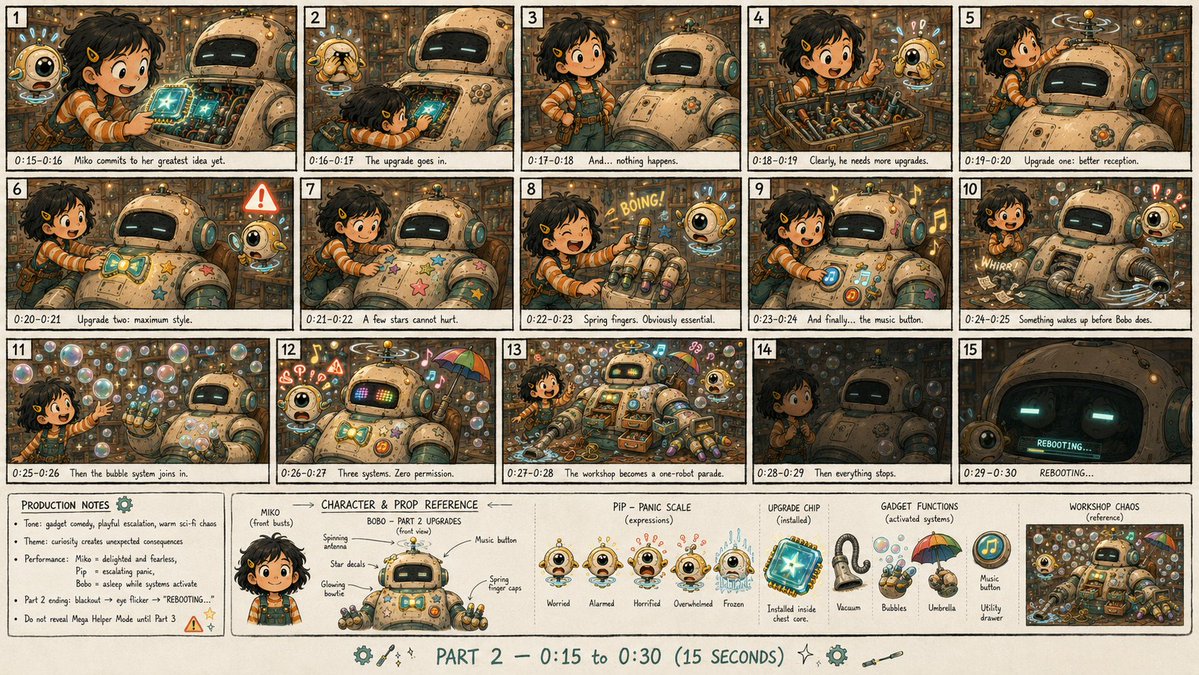
为一部原创2D动画短片《The Little Mechanic and the Sleeping Robot(小机械师与沉睡的机器人)》的第2部分(PART 2)创建一张高细节的专业故事板(s...
中文说明
为一部原创2D动画短片《The Little Mechanic and the Sleeping Robot(小机械师与沉睡的机器人)》的第2部分(PART 2)创建一张高细节的专业故事板(storyboard)单页图像。该页面应仅展示第2部分的完整15秒故事板,直接延续第1部分的内容,使用完全相同的角色、服装、比例、车间环境、视觉语言和情感基调。要让人感觉是同一个精致的动画项目:柔和绘画风格的2D卡通、温馨复古未来主义的科幻喜剧、富有表现力的表演、圆润讨喜的角色造型、温暖的车间灯光、异想天开的小道具细节,以及逐步升级的视觉幽默。 故事必须完全原创、版权安全、适合全家观看,且不含暴力元素。不得使用受版权保护的机器人设计、系列角色、徽标(logos)、品牌引用、可怕的机械、危险的电气效果、武器、有害工具,或具有威...
原始 Prompt
Create a single high-detail professional storyboard sheet image for PART 2 of an original 2D animated short titled “The Little Mechanic and the Sleeping Robot”. The sheet should present a complete 15-second storyboard for Part 2 only, continuing directly from Part 1 with the exact same characters, costumes, proportions, workshop environment, visual language, and emotional tone. Make it feel like the same polished animation project: soft painterly 2D cartoon, cozy retro-futuristic sci-fi comedy, expressive acting, rounded appealing character shapes, warm workshop lighting, whimsical gadget details, and escalating visual humor.

The story must remain fully original, copyright-safe, family-friendly, and violence-free. Do not use copyrighted robot designs, franchise characters, logos, brand references, scary machinery, dangerous electrical effects, weapons, harmful tools, or threatening transformations. All gadget malfunctions must be harmless, funny, colorful, and easy to understand.

The image should look like a professional storyboard page on a clean off-white textured paper background with neat hand-drawn panel borders, readable handwritten captions, production notes, and a clean studio-development presentation. Use subtle selective color throughout the entire board, with warm amber workshop light, cream metal, teal-blue technology glow, orange accents, mint, pink, yellow, and soft rainbow gadget lights. Use pencil-and-ink linework with soft painted fills.

At the bottom center place:

“PART 2 – 0:15 to 0:30 (15 SECONDS)”

Decorate the footer subtly with tiny gears, bolts, sparkles, warning icons, and tool doodles.

Arrange the main storyboard as exactly 15 panels in a 3-row by 5-column grid. Every panel must contain:

panel number
timestamp
clear staging
expressive acting
short readable handwritten caption beneath

The story should clearly progress:

chip installation → silly upgrades → Pip panic → harmless gadget malfunction → growing chaos → sudden blackout → Bobo begins rebooting

CHARACTER CONTINUITY — MUST MATCH PART 1 EXACTLY:

MIKO
Little girl, 7–8 years old, short fluffy black hair, one yellow hairclip, large curious dark eyes, round expressive face, teal mechanic overalls, orange-and-cream striped shirt, small brown tool belt, same shoes and proportions. She remains cheerful, inventive, fearless, and convinced she knows exactly what she is doing.
BOBO
Large friendly household robot, soft rounded cream-metal body, teal accents, broad torso, huge gentle arms, slightly worn surface, teal side panels, simple black digital face screen, small top antenna, same chest panel design from Part 1. He remains completely harmless and lovable. At the beginning of Part 2 he is still asleep.

PIP
Tiny floating helper bot, rounded yellow-white body, one huge expressive eye, small side fins, little hover ring beneath, same scale and proportions. Pip remains the comedy reaction character and becomes progressively more alarmed.
UPGRADE CHIP
Exactly the same glowing square teal-blue chip from Part 1, gold edge contacts, bright white star-shaped center, soft magical-tech glow.

WORKSHOP
Same cozy retro-future workshop:
wooden floors

curved round window
warm string lights

shelves of jars and gadgets
hanging tools

workbench
stool
potted plants
small invention shelves
warm amber lamps
teal tech glows
Do not redesign the environment between panels.
STORY CONCEPT FOR PART 2:
Miko installs the glowing upgrade chip into Bobo’s open chest panel. At first, nothing happens, so she confidently decides that Bobo needs “a few improvements.” She adds a series of silly harmless upgrades: a spinning antenna, glowing bowtie battery pack, colorful sticker stars, springy finger caps, and a music button. Pip grows increasingly horrified.
Then Bobo’s sleeping systems begin activating one by one while he is still technically asleep. One arm becomes a tiny vacuum, another releases soap bubbles, his antenna spins, his face flashes disco colors, an umbrella pops from his shoulder, and little drawers open unexpectedly. The workshop turns into escalating gadget chaos.
At the end, everything suddenly goes completely dark.

One silent beat.

Then Bobo’s digital eyes flicker on.

PART 2 ends immediately on:

“REBOOTING…”

Do not show full awake Bobo behavior yet. Save Mega Helper Mode for Part 3.

INCLUDE EXACTLY THESE 15 PANELS:

1. (0:15–0:16)
Close-up continuation from Part 1. Miko carefully holds the glowing upgrade chip beside Bobo’s open chest panel while Pip hovers nearby in absolute panic. The chip’s teal light reflects across Miko’s excited face.
Caption: “Miko commits to her greatest idea yet.”

2. (0:16–0:17)
Miko gently slides the glowing upgrade chip into a clearly matching harmless slot inside Bobo’s chest. The star symbol flashes once. Pip covers its giant eye with its tiny fins as if it cannot watch.
Caption: “The upgrade goes in.”

3. (0:17–0:18)
Miko closes the chest panel and waits proudly with hands on hips. Bobo remains completely still. Pip slowly peeks through its fins.
Caption: “And… nothing happens.”

4. (0:18–0:19)
Miko tilts her head, thinking. Then her face brightens with another idea. She opens her tool tray dramatically while Pip immediately reacts with dread.
Caption: “Clearly, he needs more upgrades.”

5. (0:19–0:20)
Miko attaches a cute little spinning antenna accessory to the top of Bobo’s head. The antenna has a tiny yellow tip and starts wobbling gently.
Caption: “Upgrade one: better reception.”

6. (0:20–0:21)
She adds a glowing bowtie-shaped battery pack or decorative power badge to Bobo’s chest. It pulses warm yellow and teal. Pip hovers beside it, scanning frantically.
Caption: “Upgrade two: maximum style.”
7. (0:21–0:22)
Miko enthusiastically sticks colorful star decals onto Bobo’s arms and shoulders. Bobo remains asleep. Pip displays a large floating warning symbol.
Caption: “A few stars cannot hurt.”
8. (0:22–0:23)
Miko places soft spring-loaded finger caps on Bobo’s hand and presses them gently. One finger boings outward harmlessly, making Miko laugh while Pip recoils.
Caption: “Spring fingers. Obviously essential.”

9. (0:23–0:24)
Miko installs one large colorful round music button near Bobo’s chest controls and proudly presses it. A tiny musical-note glow appears.
Caption: “And finally… the music button.”
10. (0:24–0:25)
First malfunction. While still asleep, one of Bobo’s arms slowly unfolds into a tiny harmless vacuum nozzle and begins sucking up loose paper scraps from the floor. Miko looks delighted. Pip looks horrified.
Caption: “Something wakes up before Bobo does.”
11. (0:25–0:26)
Bobo’s opposite hand suddenly releases dozens of floating soap bubbles. The bubbles fill the workshop around Miko and Pip. Miko tries catching one while Pip desperately dodges them.
Caption: “Then the bubble system joins in.”

12. (0:26–0:27)
The comedy escalates: Bobo’s spinning antenna rotates rapidly, his digital face flashes cheerful disco colors, and a tiny umbrella pops open from one shoulder. Pip spins around surrounded by warning symbols.
Caption: “Three systems. Zero permission.”
13. (0:27–0:28)
Wide chaotic workshop panel. Small drawers on Bobo pop open, harmless gadgets extend, the vacuum rolls up loose string, bubbles float everywhere, and the umbrella bumps gently into hanging lights. Miko laughs while trying to keep up.
Caption: “The workshop becomes a one-robot parade.”
14. (0:28–0:29)
Without warning, every gadget stops simultaneously. Bubbles drift quietly. The lights in Bobo’s body shut off. The workshop goes dim. Miko freezes. Pip freezes.
Caption: “Then everything stops.”

15. (0:29–0:30)
Dramatic cliffhanger close-up of Bobo’s dark digital face. After one quiet beat, two soft teal digital eyes flicker on for the first time. A tiny line or icon suggests system startup. Miko and Pip are reflected faintly in the screen, staring.
Caption: “REBOOTING…”
Keep the final panel suspenseful but cute, never scary.
BOTTOM PRODUCTION NOTES SECTION:

Create a handwritten box titled:
“PRODUCTION NOTES”
Include:

Tone: gadget comedy, playful escalation, warm sci-fi chaos
Theme: curiosity creates unexpected consequences
Performance: Miko = delighted and fearless, Pip = escalating panic, Bobo = asleep while systems activate

Part 2 ending: blackout → eye flicker → “REBOOTING…”
Do not reveal Mega Helper Mode until Part 3
CHARACTER & PROP REFERENCE SECTION:

Create a lower-side section labeled:
“CHARACTER & PROP REFERENCE”
Include small clean reference illustrations of:

MIKO — CONTINUITY
front bust
smiling inventor expression

surprised bubble reaction
teal overalls
yellow hairclip

BOBO — PART 2 UPGRADES
Show one front-view diagram with labeled add-ons:
spinning antenna
glowing bowtie battery pack

star decals
spring finger caps
music button

Keep the core body exactly the same as Part 1.
PIP — PANIC SCALE
Show 4–5 mini expressions:
worried

alarmed
horrified
overwhelmed

frozen after blackout
UPGRADE CHIP
Show the same glowing teal star chip from Part 1 with note:
“Installed inside chest core.”
GADGET FUNCTIONS
Tiny sketches:

vacuum nozzle

soap bubble hand

umbrella shoulder attachment

music button

opening utility drawer

WORKSHOP CHAOS REFERENCE
Small thumbnail showing bubbles, loose string, glowing lights, and harmless moving gadgets.
COLOR / LIGHTING NOTES:
Keep Part 2 warm and inviting:
cream robot body
teal technology glow

amber string lights

orange clothing accents

yellow upgrade details

pastel bubbles

tiny pink and mint lights

During panels 10–13, increase the amount of colorful tech glow as systems activate.
Panel 14 should dramatically reduce illumination.
Panel 15 should be mostly dim amber workshop ambience with two clean teal glowing Bobo eyes becoming the visual focus.
FINAL OVERALL STYLE:
The finished page must look like a professional animation studio storyboard sheet belonging directly after Part 1. Character faces, outfits, colors, scales, robot design, workshop geography, and prop design must remain extremely consistent.

The comedy should escalate visually from:
quiet upgrade → silly customization → one gadget → multiple gadgets → workshop chaos → total silence → reboot cliffhanger.
Keep all mechanical actions cute, harmless, visually readable, and physically simple.

No danger, no sparks that imply electrocution, no scary red eyes, no destruction, no injuries, no threatening robot behavior, no realistic exposed electronics danger, no fire, no weapons, no horror, no copyrighted designs, no logos, and no brand names.