 1/2
1/2
PROMPT RECORD图像记录
让物理规律正确,对AI来说也要棘手得多。 这正是我去年春天分析一些图像时注意到的事情。今天我偶然读到一篇非常有趣的文章,恰恰讨论了这个问题——图像中的物理与场景的几何。下面是一个简要的总结。...
中文说明
让物理规律正确,对AI来说也要棘手得多。 这正是我去年春天分析一些图像时注意到的事情。今天我偶然读到一篇非常有趣的文章,恰恰讨论了这个问题——图像中的物理与场景的几何。下面是一个简要的总结。 照片篡改的历史与摄影本身一样悠久。一幅著名的亚伯拉罕·林肯肖像,实际上是将林肯的头部叠加在了政客约翰·卡尔霍恩的身体上。斯大林曾以喷绘将政敌从照片中抹去。而约克郡的两个女孩则让无数人——包括阿瑟·柯南·道尔——相信她们拍摄的仙女照片是真的。 但我们如何判断一张数字图像是否真的真实? 数字取证专家哈尼·法里德(Hany Farid)意识到,每当计算机通过从现有像素外推来生成新像素时,都会留下可被检测的痕迹——像素之间的统计相关性。因此,挑战不在于"证明"图像是真实的,而在于识别不同类型的篡改所留下的痕迹。最终,他得出结论:答...
原始 Prompt
Getting the physics right is much trickier even for AI.
That's exactly what caught my attention when I analyzed some images last spring. Today I came across a very interesting article that discusses exactly this issue – the physics of an image and the geometry of a scene. Here's a brief summary.

The history of photo manipulation is as old as photography itself. A famous portrait of Abraham Lincoln actually shows Lincoln's head superimposed onto the body of politician John Calhoun. Stalin famously airbrushed political opponents out of photographs. And two girls from Yorkshire convinced countless people – including Arthur Conan Doyle – that their photographs of fairies were genuine.

But how can we tell whether a digital image is actually real?

Digital forensics expert Hany Farid realized that whenever a computer creates new pixels by extrapolating from existing ones, it leaves behind detectable traces – statistical correlations between pixels. The challenge, therefore, was not to "prove" that an image was authentic, but to identify the traces left by different types of manipulation. Eventually, he concluded that the answer lies in physics.

Today, billions of people have access to AI systems capable of producing photorealistic images from almost any prompt within seconds. Early AI-generated images were often easy to spot because they lacked subtle statistical signatures present in real photographs, such as sensor noise or lens artifacts. However, modern image generators have become remarkably good at learning and reproducing these patterns, even adding realistic imperfections to mimic camera-generated images.

Physics, however, is a different story.

When analyzing an image, it's always worth asking a simple question: Does this scene obey the laws of the real world?

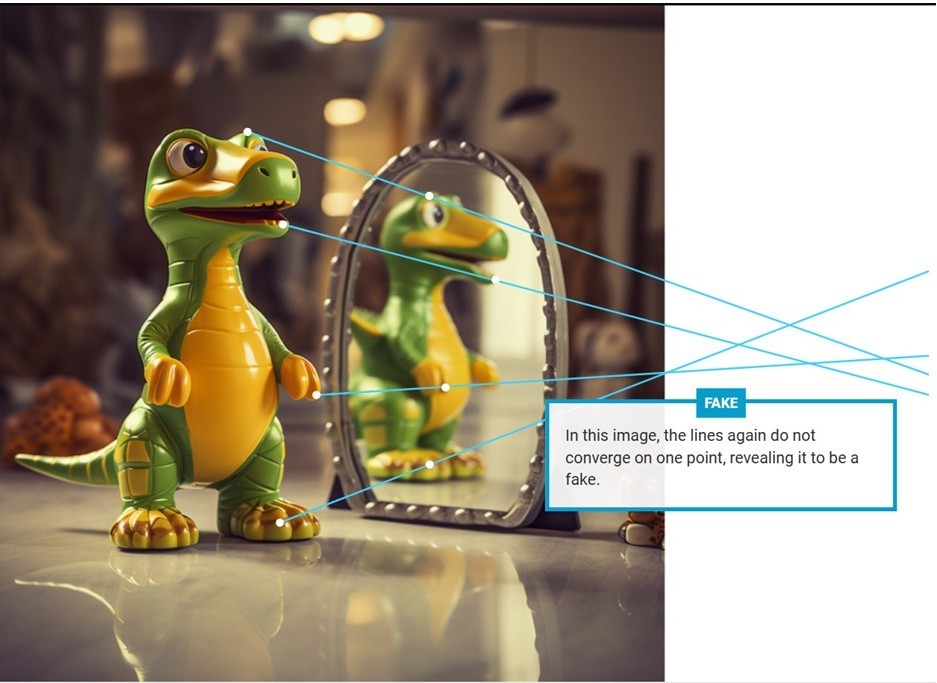
For example, in a genuine photograph, lines that are parallel in reality should converge toward the same vanishing point. Likewise, lines connecting points on an object with the corresponding points in its mirror reflection should also converge consistently according to the rules of perspective.
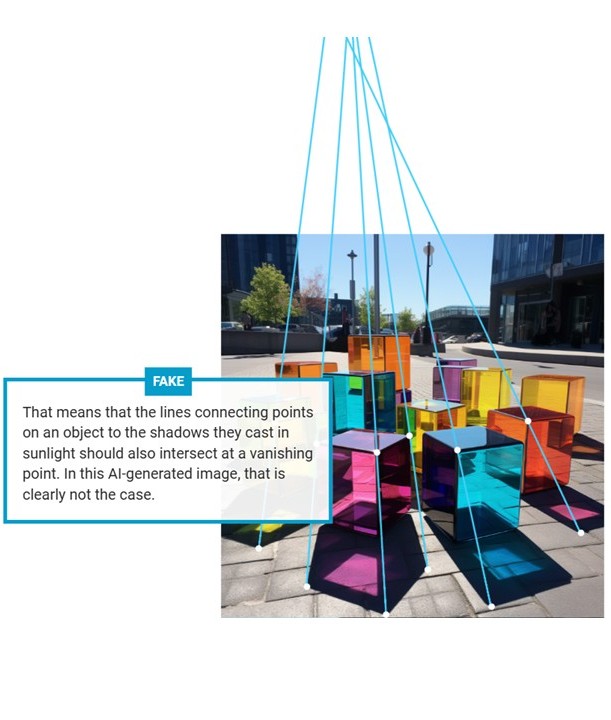
Shadows can also reveal inconsistencies. Because the Sun is so far away, its rays are effectively parallel when they reach the Earth's surface, which places strict constraints on the direction and behavior of shadows.

"Generative AI doesn't know about physics, doesn't know about geometry, and it does all kinds of crazy shit."

Source (Science): https://t.co/Kt5jJcufpm