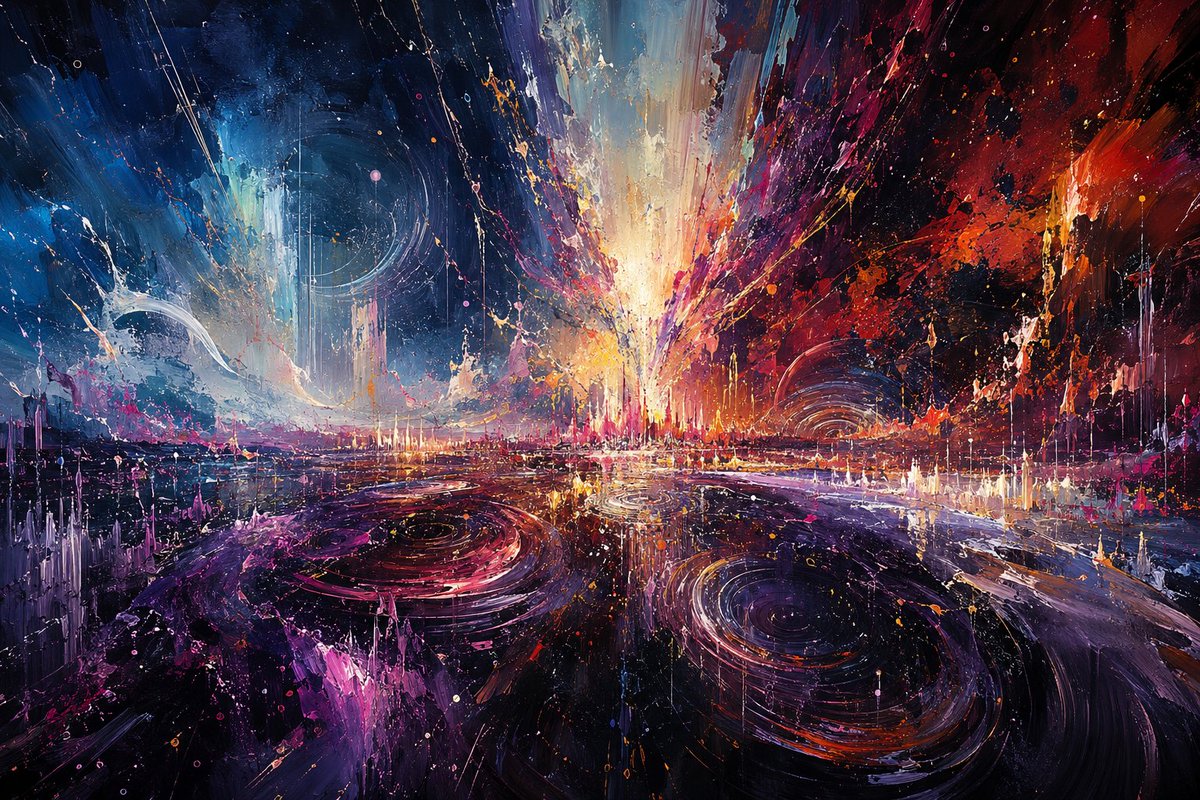
PROMPT RECORD图像记录
它分析一首上传的 mp3 歌曲(最好是 mp3)并将其转化为丙烯抽象视觉画面。其理念是更接近地复现联觉症(Chromesthesia)患者所体验到的:看到声音的"颜色/形状"。 它是如何工作的...
中文说明
它分析一首上传的 mp3 歌曲(最好是 mp3)并将其转化为丙烯抽象视觉画面。其理念是更接近地复现联觉症(Chromesthesia)患者所体验到的:看到声音的"颜色/形状"。 它是如何工作的?:打开 GPt,但使用常规的 gpt,而不是图像生成器(提示词通常会确保之后切换到生成图像),复制粘贴提示词,选择一首你喜欢的歌曲并将 mp3 文件上传到 gpt。启动生成,提示词应该在对歌曲中所有声音进行翻译、形成视觉之前,完整地分析整首歌曲。 我强烈建议在这一条上使用 gpt,并且我坚持强调这个提示词的实验性,哈哈 提示词从这里开始: ---------------------------------------------------------- [SONG / SOUND REFERENCE: uploaded...
原始 Prompt
it analyse a mp3 song (preferably mp3) uploaded and translate it into an acrylic abstract visual. The idea is to come closer to replicate what people with Chromesthesia experience: seeing the color/shapes of the sounds.

How does it works?: Open GPt but regular gpt, not the generator of image ( the prompt ensure normally it switch to gen an image after) copy paste the prompt, choose a song you like and bring the mp3 file to upload it in gpt. Launch the gen, the prompt SHOULD analyse fully the song before making a visual based on all the sounds translated from the song.

I highly advise using gpt on this one, and i insist on the experimental aspect of this prompt haha

Prompt starts here:
----------------------------------------------------------
[SONG / SOUND REFERENCE: uploaded audio file]

IMPORTANT INSTRUCTION:
Before generating the image, analyze the ENTIRE uploaded song from beginning to end.
Do not base the result on generic music assumptions.
Do not create a random abstract music image.
The image must be built only after a deep full-track analysis of the uploaded audio.
You must analyze the whole song completely, including:
overall emotional tone
emotional progression over time
intro, buildup, transition, climax / chorus, bridge / breakdown, outro

bass intensity and low-frequency pressure
drum and percussion behavior
vocal presence, intensity, fragility, aggression, or softness
melody and lead instrument movement
synths, harmonics, ambience, reverb, echoes, distortion, silence, and dynamic contrast
moments of tension, release, rupture, suspension, and decay
how the track evolves section by section across its full duration
Do not ignore any section of the song.
Do not summarize only the loudest moment.
Do not reduce the song to a single mood if the music evolves through multiple emotional states.
The final image must visually reflect the complete structure of the track from start to finish inside one coherent composition.
If the uploaded song cannot actually be fully accessed or analyzed, do not fake precision.
In that case, do not pretend the image is based on real detailed analysis.
But if the audio is accessible, the image must be specifically tied to this exact song and not be a generic chromesthesia illustration.
masterpiece, best quality, ultra-detailed, Full HD 8K, cinematic composition, high budget AAA Japanese animation movie aesthetic, expressive acrylic impressionist painting, chromesthesia-inspired abstract sound visualization fully driven by the real emotion, rhythm, texture, structure, and sonic identity of the uploaded song.
Create an image that represents the uploaded song as if the sound itself became visible through chromesthesia.

No character, no human figure, no face, no portrait, no body, no eyes.
The image must focus only on the visual display of music, emotion, vibration, rhythm, frequency, bass, vocals, instruments, silence, distortion, reverb, and sonic movement.
The entire composition is an abstract cinematic soundscape, facing the viewer directly like a vast wall of living music, with a slight downward cinematic angle, front view downward angle.
The image must not look like a random abstract painting.
It must feel like a faithful visual translation of the uploaded song’s internal architecture, emotional progression, and sound design.

ANALYSIS-DRIVEN VISUAL TRANSLATION RULES:
Translate the audio into visual language using real sonic interpretation:
LOW END / BASS / SUB-BASS
Deep bass becomes massive dark pressure waves, rounded black-violet pulses, heavy circular shockwaves, slow expanding rings, dense low-frequency ripples, gravitational distortions, and thick impasto strokes pushing through the image like physical weight.
If the bass is sustained, make it feel continuous and oppressive.
If the bass is punchy, make it strike in distinct pressure impacts.
If the bass is absent or restrained, reduce these forms accordingly.

DRUMS / PERCUSSION / RHYTHM
Drums and percussion become sharp rhythmic impacts, splattered paint bursts, fractured geometric flashes, repeated strike marks, vibrating particles, explosive acrylic accents, and directional attack lines synchronized to the beat.
Fast percussion should create dense rhythmic fragmentation.
Slow heavy percussion should create fewer but more violent impact signatures.
Syncopation should feel visually unstable or off-balance.

VOCALS
Vocals become luminous flowing ribbons, emotional vapor trails, trembling colored threads, glowing breath-like mist, delicate waveforms, expressive brush lines, and suspended emotional currents.
Soft vocals should feel intimate, transparent, fragile, and dissolving.
Powerful vocals should swell into brighter and larger visual arcs.
Broken, strained, or aggressive vocals should distort the line quality into rough unstable streaks.

MELODY / LEAD INSTRUMENTS
Melody and lead instruments become bright streaks of color, curved light trails, crystalline arcs, neon paint scratches, singing lines, sparkling fragments, and expressive painterly currents crossing the canvas.
Smooth melodic lines should arc gracefully.
Erratic melodies should flicker, fracture, or twist unpredictably.
Repetitive motifs should produce recurring visual patterns.

SYNTHS / ATMOSPHERE / REVERB / ECHO
Synths, reverb, echoes, pads, and atmospheric layers become transparent veils of light, floating halos, blurred chromatic clouds, ghostly afterimages, soft glowing gradients, distant color fog, and volumetric mist spreading through the background and between forms.
Long reverbs should visually linger.
Echoes should produce repeated fading traces.
Ambient textures should create depth and breathing space.

DISTORTION / TENSION / HARSHNESS / NOISE
Distortion, tension, harsh sounds, compression stress, abrasive textures, or emotional violence become jagged palette-knife cuts, rough torn textures, unstable color fractures, aggressive paint splashes, broken lines, visual static, and chaotic sonic debris.
If the song contains pressure, anguish, or sonic overload, show that in the physical violence of the paint itself.

SILENCE / QUIET / BREATHING SPACE
Silence or quieter moments become negative space, dark breathing gaps, softened blurred regions, suspended particles, fading smoke, thin distant waves, empty visual pauses, and lowered texture density.
These areas must feel intentional, like the music breathing.
FULL-TRACK STRUCTURE MAPPING:

The image must show the evolution of the full song inside one single unified composition:

The intro appears as sparse, distant, atmospheric shapes, restrained movement, and low-density visual signals.

The early development gradually introduces more layers, more motion, and more color presence.
The buildup grows into layered waves, rising color density, accelerating brush movement, increasing light pressure, and visual anticipation.
The chorus or main climax becomes the brightest, most saturated, most forceful central event in the image.
Secondary peaks or repeated choruses should create echoed or mirrored expansions of that central force.
The bridge / breakdown must visibly shift the internal logic of the composition: unstable, suspended, dreamlike, fractured, stripped-back, or emotionally exposed depending on the song.

The outro dissolves into fading trails, echoes, particles, thinning waveforms, residual glow, and atmospheric color haze.
The composition must communicate not only sound, but the sequence of sound over time.
It must feel as if the viewer can “read” the musical journey from start to finish through the visual flow.
EMOTIONAL ANALYSIS RULE:
Do not force a predetermined emotion unless the song truly supports it.
Detect the actual emotional tone of the uploaded song and let all visual decisions be governed by that real emotional reading.
If the track evolves emotionally, the image must preserve that evolution instead of flattening it.
Brushwork, texture, and movement must adapt to the emotional truth of the music:
violent and chaotic for rage, intensity, aggression, or distortion

soft and dissolving for sadness, nostalgia, intimacy, or tenderness
fractured and unstable for fear, anxiety, dread, or tension
explosive and radiant for joy, triumph, power, or release
cold and restrained for emptiness, loneliness, detachment, or numbness
surreal and warped for madness, mystery, unreality, or dreamlike instability

heavy and oppressive for grief, despair, tragic beauty, or fatalism
COLOR ANALYSIS RULE:
The color palette, lighting, contrast, and composition must emerge from the actual emotional and sonic identity of the uploaded song.
Examples of emotional color behavior:
warm burning reds, oranges, and golds for rage, heat, urgency, or passion
desaturated blues, greys, and pale violets for sorrow, melancholy, or emotional distance

sickly greens, bruised purples, and deep shadows for fear, corruption, or instability
radiant golds, whites, and sky-like blues for hope, transcendence, or uplift
deep blacks, crimson, and violet for despair, doom, or tragic intensity
surreal contrasting colors, neon fractures, and impossible gradients for emotional instability, hallucination, or conflict
soft pearlescent tones, silver haze, and translucent pastels for dreamlike wonder, delicacy, or suspended beauty

MATERIAL / PAINTERLY EXECUTION:
The full image becomes a heavily textured acrylic painting with visible brush swipes, aggressive palette knife strokes, thick impasto paint, layered pigments, visible canvas texture, emotional paint splatter, chaotic painterly energy, and raw tactile depth reacting directly to the music.
ultra expressive impressionism, raw chromesthetic emotion, psychological intensity, emotional realism through painterly abstraction, cinematic anime key visual composition, no characters, no faces, no bodies, pure visualized sound, devastating emotional impact.
heavy brushes, visible paint textures, slight blur, painterly motion blur, atmosphere particles, cinematic depth of field, rim lighting, volumetric lighting, atmosphere light, dramatic shadows, emotional abstraction, thick acrylic paint, impasto textures, palette knife strokes, expressive texture everywhere.

cinematic angle, anime key visual composition, sharp focus on the central sonic explosion, volumetric lighting, rim lighting, atmosphere light, paint effects and texture, depth of field, brush blur effect, particles, visible vibration, musical waveforms, and chromesthetic light trails.
FINAL GOAL:
The final image must feel like the uploaded song itself has become visible:
bass as weight,
drums as impact,
vocals as breath,
melody as light,
atmosphere as space,
distortion as damage,
silence as void,
and emotion as the force controlling the entire composition.
This must be a full-song chromesthetic translation, not a generic abstract image.

----------------------------------------------------------
End of prompt
example: The Specter - Alan Walker