PROMPT RECORD图像记录
“将资金转移至最高收益的稳定币,并每周进行再平衡。” 其余工作由智能体(agent)处理。 真正的新变化在于…… 这些能够做到以下几点的系统: 通过嵌入式或抽象化钱包持有资产。 跨任务维持记忆...
中文说明
“将资金转移至最高收益的稳定币,并每周进行再平衡。” 其余工作由智能体(agent)处理。 真正的新变化在于…… 这些能够做到以下几点的系统: 通过嵌入式或抽象化钱包持有资产。 跨任务维持记忆。 直接在链上(onchain)执行交易。 无需人类输入即可与多个协议交互。 这些智能体不仅会响应,还会行动、追踪,并随着时间推移自我适应。 这让加密货币从一种“你操作的工具”转变为一种“为你操作的工具”。 当前已经上线的进展 多个团队已经拥有真实使用中的可用系统。 1. @Unibase_AI —— 正在构建以记忆优先(memory-first)的智能体技术栈。 经过 ZK 验证的记忆层 —— 智能体身份标准(ERC-8004) 支持原生支付的自主钱包 早期信号:开发者已经在测试多步骤流程,例如使用持久化记忆进行跨协议执...
原始 Prompt
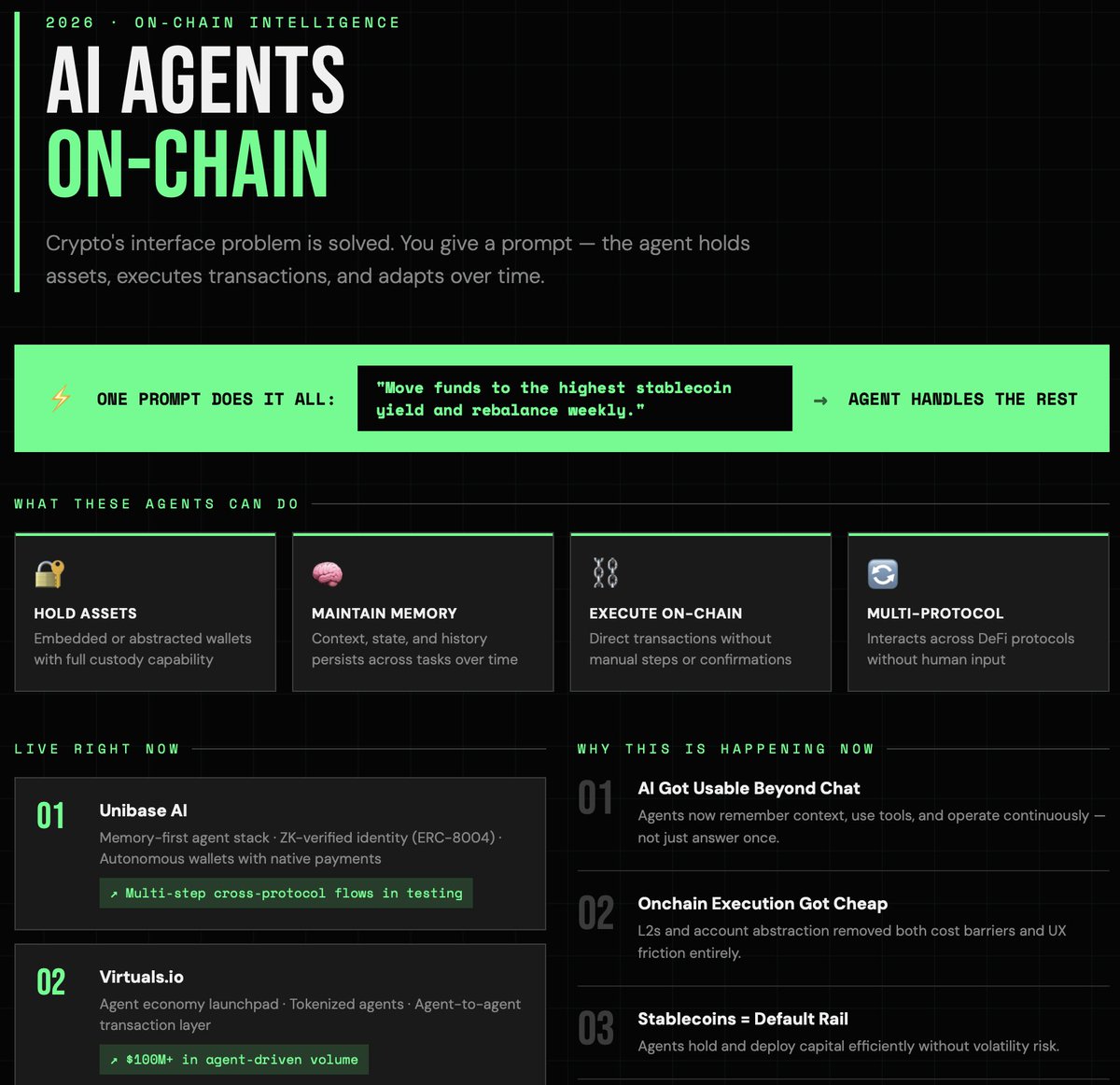
“Move funds to the highest stablecoin yield and rebalance weekly.”

The agent handles the rest.

What’s new here are…

The systems that can:
Hold assets through embedded or abstracted wallets.

Maintain memory across tasks.

Execute transactions directly onchain.

Interact with multiple protocols without human input.

These agents don’t just respond, they act, track, and adapt over time.

This turns crypto from a tool you operate into something that operates for you.

What’s live right now

Several teams already have working systems with real usage.

1. @Unibase_AI - building a memory-first agent stack.
ZK-verified memory layer - agent identity standard (ERC-8004)

Autonomous wallets with native payments

Early signal: developers are already testing multi-step flows like cross-protocol execution using persistent memory.

Not one-off actions, but sequences.

2. @virtuals_io - an entire economy around agents.
Launchpad for deploying agents
Tokenized agents with monetization
Agent-to-agent transaction layer

Early signal: agent-driven economic activity has already reached hundreds of millions in volume, with revenue coming from subscriptions and automated services.

3. @Fetch_ai - one of the earliest players, now pushing deeper into execution.

Autonomous agents that negotiate and transact.

Strong focus on coordination across systems

Early signal: updated tooling in 2026 is making it easier for enterprises and DeFi users to automate workflows that previously required manual oversight.

4. @autonolas - focused on coordinated agent systems.

Multi-agent “swarms” for complex tasks with onchain verification and shared revenue models.

Early signal: increasing use in scenarios where one agent isn’t enough, like coordinated execution across markets or protocols.

Why this is happening now

1. AI got usable beyond chat. Agents now remember context, use tools, and operate over time instead of answering once.

2. Onchain execution got cheap. L2s and account abstraction removed cost and UX barriers.

3. Stablecoins became the default rail
Agents can hold and deploy capital efficiently without volatility risk.

Put together, this creates something new:
AI becomes the interface.

Blockchain becomes the execution layer.

There’s also a shift in trust models.

Instead of “Know Your Customer,” systems are moving toward verifiable agents with defined permissions, identities, and constraints.

- Where the upside is
If this works, agents become the layer users actually interact with.

Not wallets, not dApps, just intent.

One prompt could replace: manual portfolio management, yield hunting across protocols, outine trading or rebalancing, and data monitoring and execution.

That’s the kind of simplification crypto has been missing.

The biggest opportunities tend to sit in:
Memory layers (state, context, history)

Coordination protocols (agent-to-agent interaction)

Execution infrastructure (secure, verifiable actions)

Because once an agent is trusted and funded, switching costs become high.

- What could break?
Security - an agent with funds and autonomy is a new attack surface. If it’s compromised, losses can scale quickly.

Fragmentation - too many standards and frameworks competing. Liquidity and developers get split.

Regulation - if an agent makes a trade, who is responsible? The user, the developer, or the protocol?
These questions are still open.

- What to watch from here
A few signals matter more than hype: Growth in agent-controlled wallets

Transaction volume initiated by agents
Agent-to-agent interactions (not just human-triggered)

- Where to start
If you want to understand this shift, don’t just read about it.

try an agent interface on active ecosystems like Base.

look at onchain dashboards tracking agent activity.

run simple prompts and see what actually executes.

The difference becomes obvious when you use it.
AI agents on-chain are still early but they’ve moved past demos into true usage.

Crypto has been waiting for a better interface for years.
This might be it.