PROMPT RECORD图像记录
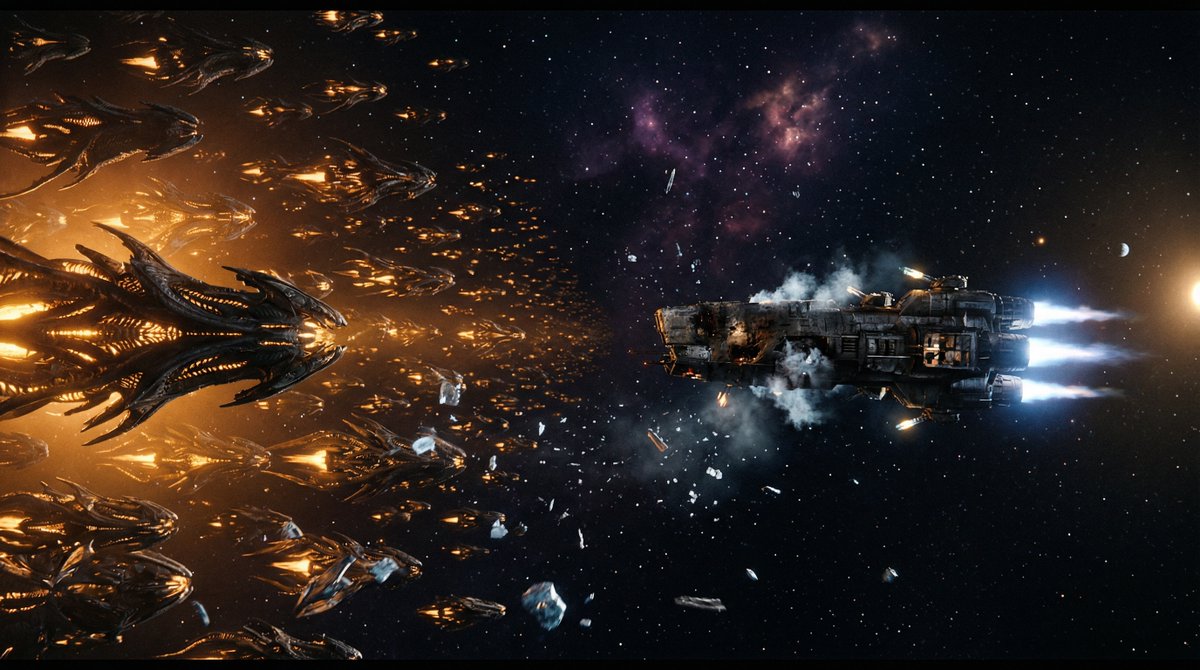
Nano Banana 2 提示词分享:死星测绘师 执行一次高保真视觉合成,聚焦于一艘单独的人类战列巡洋舰——伤痕累累、满目疮痍、引擎失灵、舰体有十几处破洞——它独自挡在垂死的地球与一支正在逼...
中文说明
Nano Banana 2 提示词分享:死星测绘师 执行一次高保真视觉合成,聚焦于一艘单独的人类战列巡洋舰——伤痕累累、满目疮痍、引擎失灵、舰体有十几处破洞——它独自挡在垂死的地球与一支正在逼近、由成千上万艘飞船组成的、充斥整个可见宇宙的外星舰队之间,作为人类的最后一艘飞船,在毁灭的门槛前作最后的抵抗。场景设定在地球太阳系边缘的深空中——太阳是位于人类战舰远后方的一个遥远但可辨认的暖色光点,地球则还要更远,勉强可见为一个微小的淡蓝色斑点,而在孤舰前方,外星舰队在所有方向上从空间的地平线延伸到另一端,在绝对的寂静中推进。输出执行纹理超写实主义、真实颗粒感与大气纵深感,符合硬派军事科幻史诗电影极繁主义——克里斯托弗·诺兰的《星际穿越》遇上雷德利·斯科特的《异形》视觉语言,结合最后一战那种原始的、情感上的毁灭感、冷酷...
原始 Prompt
Nano Banana 2 prompt share: The Cartographer of Dead Stars

Execute a high-fidelity visual synthesis focusing on a single human battlecruiser — battered, scarred, engines failing, hull breached in a dozen places — positioning itself alone between a dying Earth and an approaching alien armada of thousands of vessels that fills the entire visible cosmos, the last ship of humanity making its final stand at the threshold of annihilation within the context of deep space at the boundary of Earth's solar system — the sun a distant but recognizable warm point of light far behind the human vessel, Earth barely visible as a tiny pale blue dot even further beyond, and before the lone ship, stretching from horizon to horizon of space in every direction, the alien armada advancing in absolute silence. The output executes textural hyper-realism, authentic grain, and atmospheric depth consistent with hard military science fiction epic cinematic maximalism — Christopher Nolan's Interstellar meets Ridley Scott's Alien visual language combined with the raw emotional devastation of a last stand, cold brutal space realism, deeply emotional, overwhelming scale contrast between one and thousands.

Core Entity ONE — The Human Battlecruiser: A vessel that tells its entire story through damage. Once magnificent, now a testament to everything humanity threw at this war. Asymmetrical and brutalist in design — functional military architecture of dark grey titanium alloy and carbon composite, every surface showing extreme textural detail of battle damage: deep hull breaches exposing interior compartments venting atmosphere as frozen crystal clouds into space, entire weapon turret sections sheared away, hull plating buckled and scorched black from energy weapon impacts, one of four main engines completely dark and dead while the remaining three burn with struggling blue-white ion flame. Yet the ship is not broken — it is turning deliberately, positioning itself broadside to the approaching armada in the classic gesture of defiance, every remaining weapon system still active and charging, their barrel tips glowing with building energy. The human vessel occupies approximately one tenth of the frame — deliberately small against the cosmos, its scale comprehensible and human against the incomprehensible alien mass approaching. Hull markings barely visible through battle damage: a registration number, a national flag of Earth, a name plate reading nothing — left intentionally for the viewer to fill.

Core Entity TWO — The Alien Armada: Not individual ships but a phenomenon — a wall of alien vessels so numerous they constitute a new geography of space. Thousands upon thousands of bio-mechanical vessels of varying scale from fighter-sized to moon-sized, arranged not in military formation but in the organic clustering pattern of a vast living organism — the armada breathes and pulses as one entity. The individual vessels: consistent with the established alien aesthetic — dark living metal, amber bioluminescent membrane panels pulsing in synchronized waves across the entire armada like a single heartbeat visible across thousands of ships, organic hull textures of extraordinary complexity. The armada fills the entire left half of the frame from top to bottom, its depth extending back into infinity — the nearest vessels razor-sharp in detail, subsequent ranks dissolving into a mass of bioluminescent amber and deep shadow that stretches to the vanishing point of space itself. The sheer mass of the armada creates a visible gravitational lens effect — distant stars behind it bent slightly, space itself warping around the collective mass.

Environment: Deep interstellar space of extraordinary cinematic beauty despite its terror — pure black cosmic void as the dominant backdrop, razor-sharp individual stars scattered throughout, a spectacular distant nebula of deep violet and rose gold visible in the far background upper right, the Milky Way as a faint luminous band across the upper frame. Far behind the human vessel, barely visible but unmistakably present: the warm pale gold point of our Sun, and even further, so small it is almost not there — a single pale blue pixel. Earth. The space between the lone ship and the armada: not empty — filled with the debris of the battles that led here, frozen fragments of destroyed human vessels catching starlight like a field of man-made stars, a slowly expanding cloud of crystallized atmosphere from previous hull breaches drifting in perfect silence.

Composition: Anamorphic frame 2.39:1. The most deliberately asymmetric composition possible — the lone human battlecruiser occupies the right quarter of the frame, positioned broadside, its full damaged profile visible, engines burning toward the left. The alien armada fills the entire left three quarters of the frame, advancing from the left edge, its nearest vessels close enough to show surface detail, its mass extending back to infinity. The human ship is heartbreakingly small. The debris field of fallen human ships occupies the space between them. The Sun and Earth are visible as tiny warm points far to the right behind the lone ship — everything humanity ever was, reduced to a point of light worth dying for.

Depth of Field: T-stop emulation f/2.2 — the human battlecruiser's hull surface razor-sharp with extreme damage detail, the nearest alien vessels crisply detailed, the armada mass receding into deep space bokeh of bioluminescent amber blur, the debris field catching starlight in sharp crystalline detail throughout the mid-ground.

Camera: Arri Alexa 65 sensor output, 35mm Master Prime lens, 8K resolution downsampled for extreme cinematic density. Perfectly locked off — zero movement, zero shake. The stillness of space itself. The camera holds this moment with the solemnity of a war memorial.

Optics: Distinct chromatic aberration on the battlecruiser's hull breach edges and weapon charging points, organic halation blooming around the struggling engine flames and weapon charge glow, the alien armada's collective bioluminescence creating a vast amber halation that washes the entire left half of the frame in warm dying light, classic anamorphic horizontal lens flare from the brightest engine flame cutting across the human ship.

Texture: Real Kodak Vision3 500T 35mm film grain, silver halide noise, high-bitrate broadcast density, raw untreated negative look — the image feels like a transmission received long after it was sent, from somewhere that no longer exists.

Lighting: Cold, brutal and poetic — the alien armada's collective bioluminescent amber as a vast warm key light from the left, illuminating the human ship's damaged port side in an almost tender golden light that feels deeply wrong given its source, the struggling blue-white ion engine flames as the human ship's own cold self-illumination from behind, the distant Sun casting the faintest possible warm rim light on the starboard side of the human vessel from the right — the light of home, barely reaching, deep cosmic darkness filling every other space, the debris field catching both light sources in cold crystalline glints throughout.

Photorealistic movie still, 35mm motion picture film stock, cold hard military science fiction color grading — deep space blacks, cold blue-white human technology against warm alien amber, the pale gold of a distant sun as the emotional anchor of the entire image, authentic non-processed RAW image science. No text, no letters, no words inside the image.