 1/4
1/4
PROMPT RECORD图像记录
打开城门!放下吊桥!把好银器藏起来!现在是JOLLY的每日提示时间! 你是否曾想过成为自己二战浪漫故事的一部分?现在你可以了。图片灵感来自我祖父的一张穿着军装的真实照片。 特别感谢:@3p0n...
中文说明
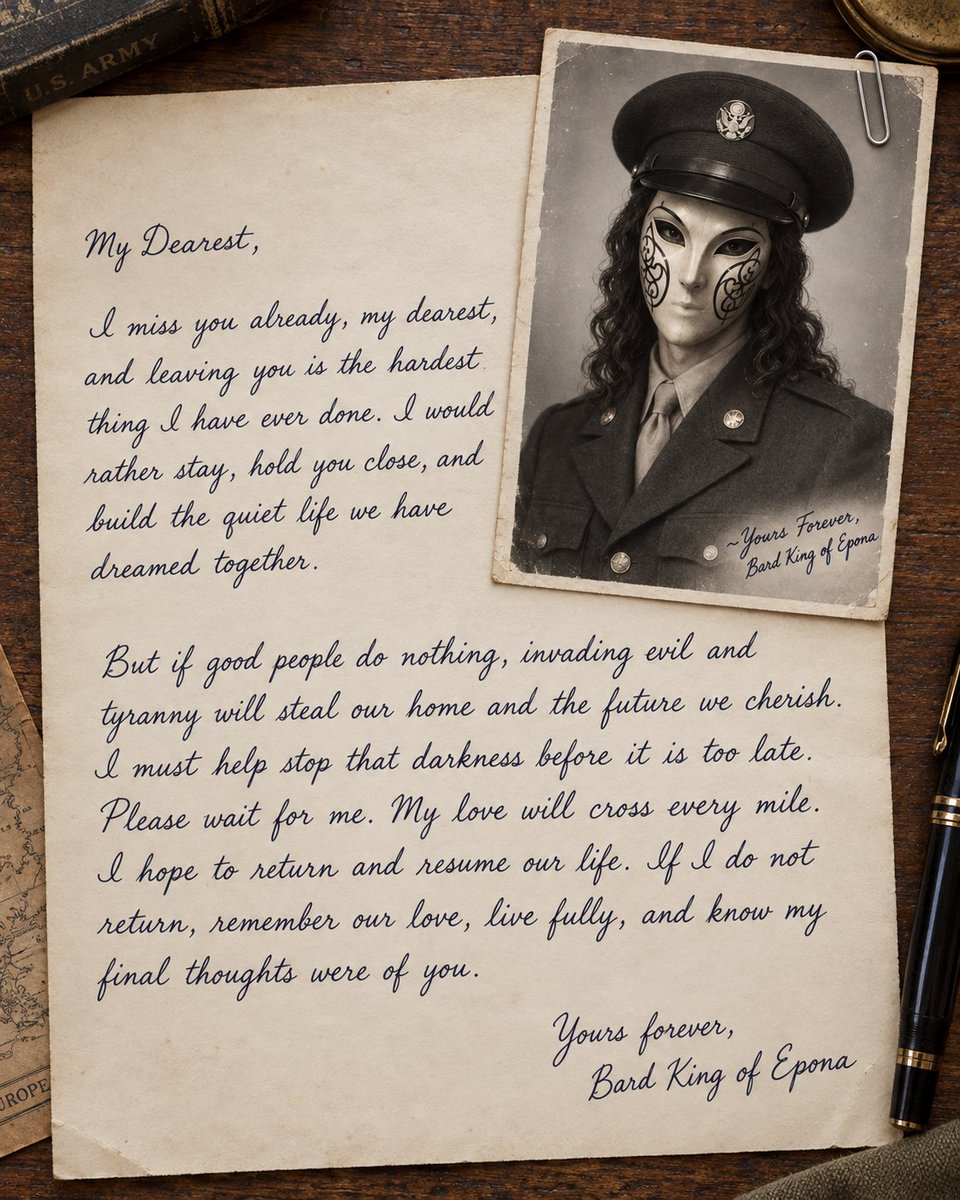
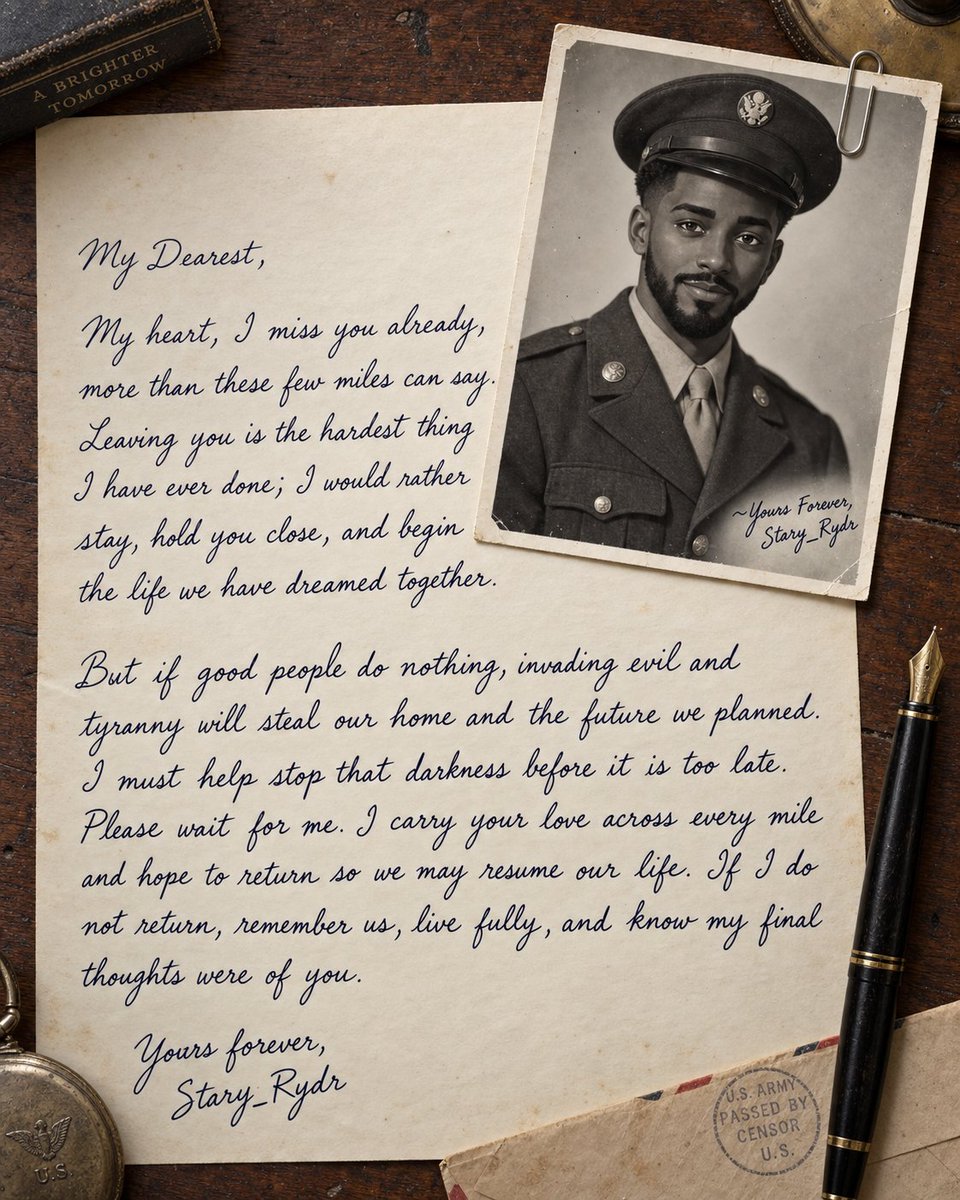
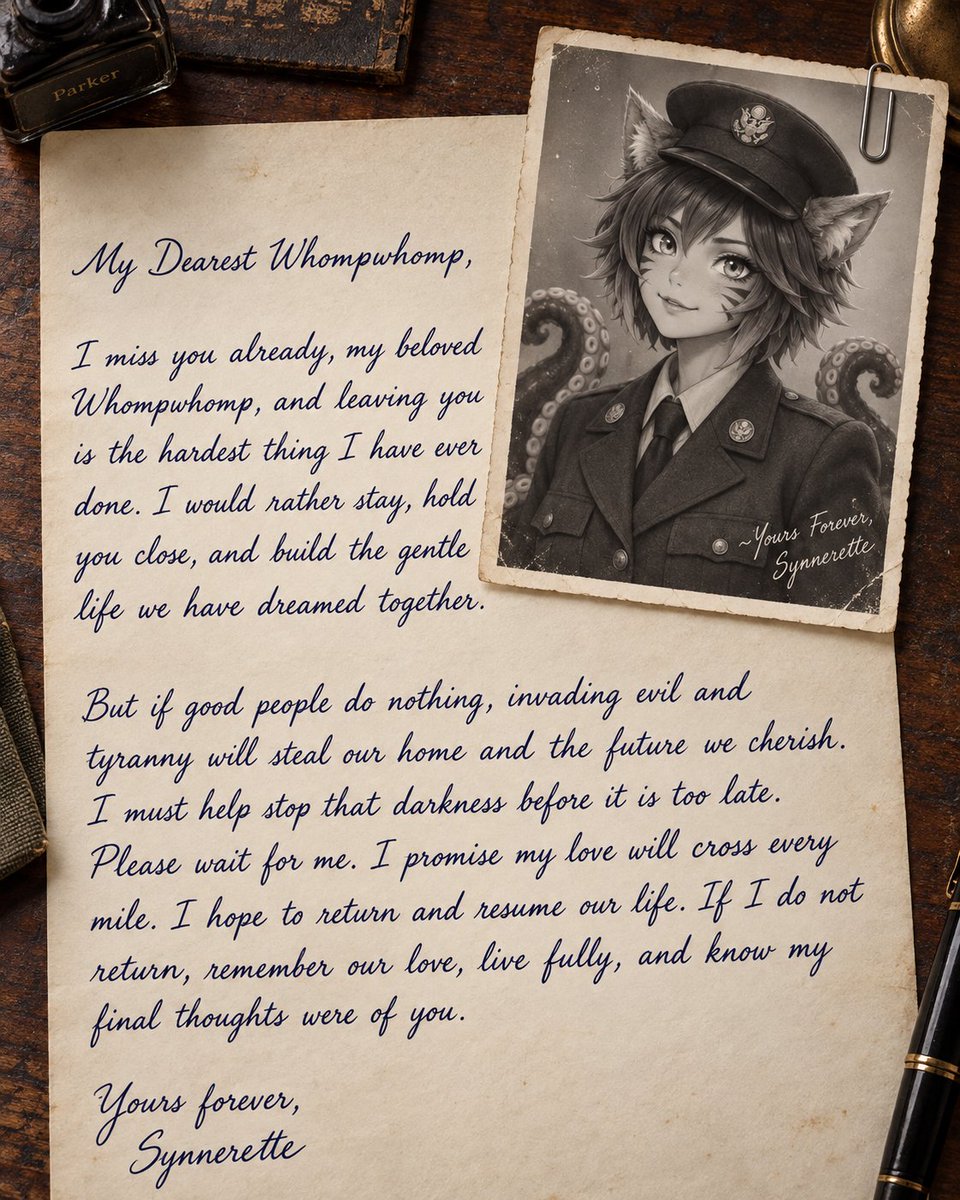
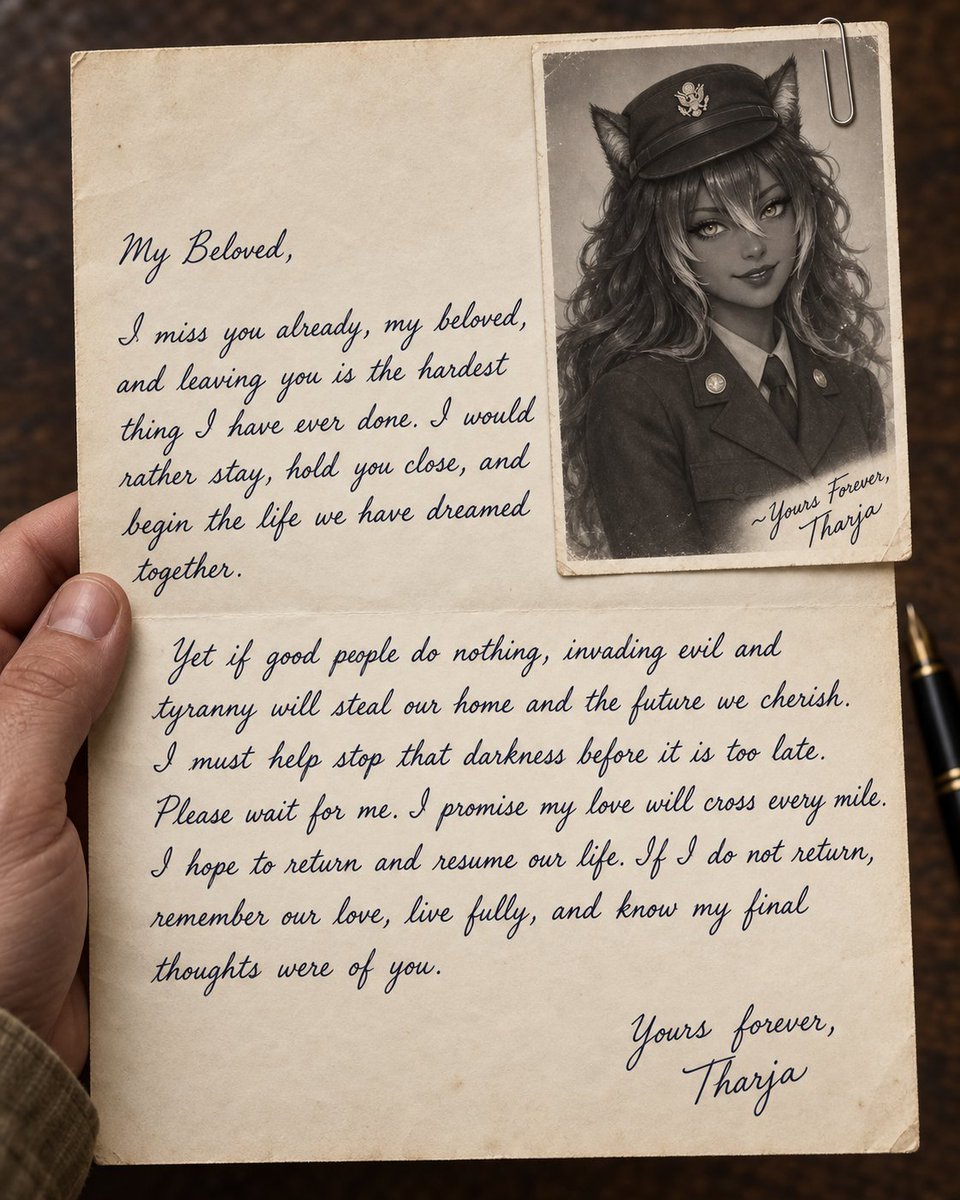
打开城门!放下吊桥!把好银器藏起来!现在是JOLLY的每日提示时间! 你是否曾想过成为自己二战浪漫故事的一部分?现在你可以了。图片灵感来自我祖父的一张穿着军装的真实照片。 特别感谢:@3p0n4r0xx0rs、Stary_Rydr、@Synnerette 和 Tharja (如果可以请艾特 Stary_Rydr 和 Tharja,不知道为什么我不能@他们???) 永远属于你 — Jolly Joebean 的一战书信 提示开始 ---------------------- OC NAME: [在此插入OC的名字] LOVED ONE'S NAME: [在此插入女友、男友、丈夫或妻子的名字,或留空] RELATIONSHIP: [Girlfriend / Boyfriend / Husband / Wife —...
原始 Prompt
Open the gates! Lower the drawbridge! Hide the good silverware! It’s time for JOLLY’S PROMPT OF THE DAY!
Have you ever wanted to be part of your own WWII romance story? well now you can be. the image is based off an actual photo of my grandfather in his uniform.
Special Thanks To: @3p0n4r0xx0rs , Stary_Rydr, @Synnerette , and Tharja

(If you can please tag Stary_Rydr and Tharja, it won't let me for some reason???)

Yours Forever — WWI Letter by Jolly Joebean

PROMPT START
----------------------

OC NAME: [insert the OC's name here]
LOVED ONE'S NAME: [insert the girlfriend's, boyfriend's, husband's, or wife's name here, or leave blank]
RELATIONSHIP: [Girlfriend / Boyfriend / Husband / Wife — or leave blank for the AI to choose]
PRESENTATION: [Desk / Table / Held — or leave blank for the AI to choose]

Attach one reference image only.

Designate the attached OC reference as @Image1.

@Image1 = the only character identity and visual-design reference.

No historical photograph is required. The uniform, pose, crop, lighting, aging, and dedication placement are defined below.

Create one keepsake image containing two physical artifacts:

1. A sheet of period stationery visibly bearing a complete short wartime love letter written by the OC to their girlfriend, boyfriend, husband, or wife.
2. A smaller black-and-white World War II-era studio portrait print of @Image1, paper-clipped to the letter's upper-right corner, using the uniform and photographic presentation defined below.

Both artifacts are mandatory in the same image. It is incomplete if the letter, salutation, signature, or any message text is absent, blank, hidden, cropped, folded over, or unreadable.

Honor people who left those they loved to resist invasion, tyranny, fascism, and evil threatening the free world. Treat Allied service, sacrifice, duty, and faithful love sincerely. Never glamorize or imitate Nazi, Axis, fascist, white-supremacist, or enemy imagery.

@Image1 alone supplies the character portrayed. The built-in historical template below controls wardrobe and photographic presentation without requiring another image.

----------------------
INPUT AND FALLBACK LOGIC
----------------------

OC NAME:

- Use the entered OC NAME exactly wherever the character signs the portrait or letter.
- Correct ordinary capitalization only if clearly accidental, but never rename the OC.
- Do not leave placeholder text in the final portrait or letter.
- If OC NAME is blank, infer a fitting name only if @Image1 visibly contains an established readable name. Otherwise ask for the OC's name before generating; do not invent one without evidence.

LOVED ONE'S NAME:

- If provided, address the recipient naturally by that exact name in the letter.
- If blank, use an affectionate period-appropriate salutation such as "My Dearest," "My Darling," or "My Beloved," without inventing a name.

RELATIONSHIP:

- If provided, treat it as authoritative and write the romance accordingly.
- If blank, choose one of the four listed relationships and keep all wording consistent with that choice.
- Do not confuse the OC with the recipient.
- Do not mention the input labels or explain which fallback was selected.

PRESENTATION:

- Follow the selected mode; if blank, choose one without combining modes.
- Desk or Table: lay the keepsake on the named period wooden surface.
- Held: show it toward the viewer in the recipient's hand. Girlfriend/Wife requires a woman's hand; Boyfriend/Husband requires a man's. If RELATIONSHIP was blank, choose it first. Show only a natural hand and minimal period sleeve, never the recipient's face or body. Wife/Husband may have one plain wedding band; Girlfriend/Boyfriend should not.

----------------------
CHARACTER IDENTITY AND HISTORICAL TEMPLATE — HIGHEST PRIORITY
----------------------

@Image1 controls the OC's identity. Deeply analyze and preserve:

- Face shape and facial structure
- Hairstyle and hair color, translated accurately into black-and-white values
- Eye shape and eye color, preserving the correct value relationship even though the portrait is monochrome
- Skin, fur, scale, feather, metal, or material tone
- Body type and proportions
- Age range and gender presentation
- Species, race, and non-human anatomy
- Ears, horns, antlers, muzzle, beak, tail, wings, markings, mechanical components, or other defining traits if visible
- Signature facial markings and small identity-critical accessories
- Personality and emotional energy
- Overall silhouette and unmistakable individual identity

The built-in historical template controls:

- The World War II-era United States Army enlisted service-dress uniform
- The peaked service cap and its slight rakish tilt
- The collared shirt and neatly centered tie
- The buttoned dress coat with broad lapels, breast pockets, shoulder construction, and visible period hardware
- The chest-up studio framing
- The slight three-quarter body angle with the face turned toward the camera
- The relaxed upright posture
- The gentle, hopeful smile
- The soft plain studio background
- The diffuse grayscale lighting and modest contrast
- The authentic mid-20th-century photographic softness
- The physical aged-print appearance
- The lower-right handwritten dedication placement

The built-in template does NOT supply a second person, face, body, species, age, or personal identity. The only depicted subject is the OC from @Image1.

Use only the uniform elements explicitly defined in this prompt. Do not invent a specific rank, medal, ribbon, unit, award, combat badge, or branch qualification. Historical restraint is more important than decorative military details.

Do not use characters, costumes, identities, or visual information from previous prompts, generations, or conversations.

----------------------
STEP 1 — TRANSLATE THE OC INTO THE HISTORICAL PORTRAIT
----------------------

Reimagine @Image1 as a real person or physically present non-human servicemember who could have sat for this studio portrait during World War II. Preserve the OC's identity exactly while translating stylized artwork into believable period photography.

If @Image1 is human or humanoid, render natural skin, hair, eyes, and anatomy without changing recognizable features.

If @Image1 is an animal, monster, fantasy being, alien, robot, object-headed character, or another non-human species, preserve that species exactly. Render their traits as physically real within the monochrome photograph rather than humanizing them or hiding their anatomy. Adapt the uniform around horns, ears, wings, tails, unusual shoulders, mechanical parts, or other anatomy in a believable tailored manner.

If the OC normally wears glasses or a small identity-critical facial accessory, retain it only when it can plausibly exist in a 1940s portrait. Translate it into a period-appropriate material and design. Large weapons, modern electronics, fantasy weapons, capes, oversized props, and the OC's original outfit must not appear.

The OC should look dignified, young-at-heart, loving, and brave. Give them an open, gentle, hopeful smile, as though this photograph was made for the person waiting at home. Do not make them look bloodthirsty, cruel, smug, threatening, or eager to kill.

----------------------
STEP 2 — UNIFORM LOCK
----------------------

Dress the OC in an authentic World War II-era United States Army enlisted service uniform. Use this exact construction and presentation:

- Dark peaked enlisted service cap with a rounded crown, short visor, front band, and centered U.S. Army-style eagle device
- Cap worn at a slight, natural rakish angle
- Light collared dress shirt
- Neatly tied period necktie
- Dark service coat with broad notched lapels
- Structured shoulders and period-correct seams
- Buttoned front
- Flapped breast pockets
- Small round collar or lapel discs in restrained, symmetrical, period-correct placement
- Plain, orderly, inspection-ready appearance

The uniform must read immediately as Allied United States Army service dress from the World War II era, not as a modern military uniform, costume-shop outfit, fashion uniform, science-fiction uniform, or the uniform of another nation.

Use only the modest U.S. Army-style cap device and small round collar or lapel discs defined above. Do not award the OC an invented rank or military honor. Do not add a helmet, firearm, ammunition, medals, ribbons, campaign bars, armbands, patches, flags, or combat equipment.

Never include a swastika, SS rune, Totenkopf, Nazi eagle, fascist emblem, Axis insignia, Nazi-style armband, enemy uniform, or any symbol associated with Nazi Germany, fascism, racial supremacy, or genocide. Do not borrow the tailoring, cap shape, collar treatment, color logic, or visual intimidation of Nazi or SS uniforms. This is exclusively an American Allied tribute.

----------------------
STEP 3 — POSE, FRAMING, AND EXPRESSION LOCK
----------------------

Follow this portrait arrangement closely:

- Vertical photographic orientation
- Chest-up framing
- Torso turned slightly away from a straight-on view
- Head turned toward the camera
- Service cap tilted slightly
- Shoulders relaxed but posture upright
- Eyes meeting the camera
- Warm, sincere, slightly boyish or tender smile appropriate to the OC
- Enough negative space around the cap and shoulders to feel like a real studio print
- Lower-right area reserved for the handwritten dedication

Do not copy incidental damage or crop away essential OC traits. If the OC has large ears, horns, hair, or another tall feature, expand the upper framing slightly so the complete silhouette remains visible while retaining the same chest-up photographic character.

The pose must feel natural and unforced. Do not use a salute, battle stance, weapon pose, pin-up pose, fashion pose, superhero pose, or neutral character-sheet stance.

----------------------
STEP 4 — PHOTOGRAPHIC STYLE AND PHYSICAL PRINT
----------------------

Render the portrait as an authentic black-and-white World War II-era studio photograph printed on physical photographic paper.

Required visual qualities:

- True grayscale image, not modern full color and not colorized
- Soft diffuse studio illumination
- Gentle facial modeling with believable shadows
- Plain light-gray studio backdrop with subtle tonal variation
- Modest period contrast and slightly softened optical detail
- Fine film grain
- Faint silver-gelatin print character
- Slightly warm aged-paper cast around the margins only
- Minor age specks, hairline scratches, faint corner wear, or gentle unevenness
- Natural historical softness without destroying facial recognition
- Believable fabric weave, buttons, visor, and insignia surfaces
- No digital filters, artificial vignette presets, fake mobile-camera effects, or modern glamour retouching

The print should feel lovingly preserved for generations. Aging must remain restrained: do not tear the face, obscure the eyes, erase the uniform, cover the inscription, or make the photograph filthy or unreadable.

----------------------
STEP 5 — HANDWRITTEN PORTRAIT DEDICATION
----------------------

In the lower-right corner of the photograph, add one dark handwritten fountain-pen dedication that reads exactly:

~Yours Forever, [OC NAME]

Replace [OC NAME] with the actual entered OC NAME. The apostrophe-free spelling "Yours" is mandatory.

The handwriting should resemble a genuine personal 1940s inscription placed directly on the physical print: intimate, slightly slanted, naturally imperfect, and fluid. It should be legible but not typeset. It may cross a small portion of the lower coat but must not cover the face, eyes, or important identity traits.

Do not add another signature, date, rank, service number, slogan, caption, title, watermark, or printed text anywhere on the portrait.

----------------------
STEP 6 — WRITE AND VISIBLY RENDER THE LOVE LETTER
----------------------

Compose the complete letter first, then render it verbatim and legibly on the separate stationery sheet inside the image. Never substitute outside response text, scribbles, blank lines, lorem ipsum, or symbolic words.

Write in first person as the OC to their LOVED ONE. Make it intensely romantic, tender, unabashedly sappy, and reminiscent of a sincere tragic World War II love story.

The letter must be short enough to remain readable in the image: 70 to 105 words, excluding the salutation and signature. Use two brief paragraphs.

The letter must naturally say that the OC already misses their beloved; leaving is the hardest thing they have done; and they would rather stay, hold them, and build their life together. Explain that invading evil or tyranny will steal their home and dreamed-of future if good people do nothing, so the OC must help stop it before it is too late. Ask the beloved to wait; promise love across every mile; hope to return and resume their life; and add that if the OC does not return, the beloved should remember their love, live fully, and know the OC's final thoughts were of them.

Keep the enemy morally clear but general: "evil," "tyranny," "invaders," or "darkness." Exclude Nazi slogans, enemy rhetoric, racial language, atrocities, combat details, and slurs. Use understandable period romance, not modern slang, memes, political catchphrases, or contemporary jargon. Never claim certain death; make it only an "if I do not return" possibility balanced by courage, hope, and devotion.

Format the letter exactly as:

My Dearest [LOVED ONE'S NAME],

[Two brief paragraphs]

Yours forever,
[OC NAME]

If LOVED ONE'S NAME is blank, remove the empty name and use "My Dearest," "My Darling," or "My Beloved," as the complete salutation. Replace [OC NAME] with the actual OC NAME. Keep the closing capitalization and punctuation natural. Do not show brackets or placeholders in the final image.

Render it in dark blue-black fountain-pen ink on clean, lightly aged cream stationery. Use neat cursive or a legible mixed cursive-print hand, generous spacing, and large lettering. Preserve and spell-check every word, especially both names.

----------------------
COMPOSITION — PORTRAIT PAPER-CLIPPED TO LETTER
----------------------

Use a vertical 4:5 composition resembling a saved wartime letter. The full unfolded letter fills most of the frame. Secure the smaller vertical portrait over its upper-right corner with one plain silver paperclip. Reserve blank stationery beneath the portrait and flow all writing around and below it so no words are hidden. The portrait occupies about 25–30% of the sheet.

Follow PRESENTATION exactly. Desk/Table uses a near-overhead view. Held uses the correctly gendered recipient's secondary, anatomically correct hand. Always show the entire sheet, photograph, paperclip, margins, writing, and OC's face.

The portrait must overlap the stationery, not lie loose beside it. Do not use staples, tape, glue, pins, or binding. At most, add one unobtrusive fountain pen in empty background space.

The two artifacts must feel like one keepsake: a photograph left with the beloved and a letter sent before departure. The theme is not glory in war, but love accepting sacrifice so innocent people and their future may remain free.

----------------------
QUALITY TARGET
----------------------

A single polished keepsake image dominated by a fully visible, legible 70-to-105-word handwritten farewell letter, with a recognizable WWII-era portrait of @Image1 securely paper-clipped to its upper-right corner, presented on the chosen surface or in the correct recipient's hand.

Before finalizing, verify:

- A complete physical letter sheet is visible behind the attached portrait.
- The portrait is paper-clipped over blank space in the letter's upper-right corner.
- The chosen presentation and any recipient hand match the inputs.
- The letter is between 70 and 105 words, excluding salutation and signature.
- Every word of the letter is legible, correctly spelled, and fully inside the frame.

----------------------
DO NOT
----------------------

Do not change the OC's identity, species, face, eyes, markings, or non-human anatomy; humanize them; or blend in another identity.
Do not reproduce the OC's original costume beneath or instead of the uniform.
Do not modernize or replace the uniform, or invent rank, decorations, unit insignia, or military history.
Do not include weapons, battlefields, explosions, corpses, blood, gore, or visible combat.
Do not include Nazi, SS, Axis, fascist, supremacist, extremist, or enemy uniforms, insignia, symbols, flags, salutes, slogans, or propaganda.
Do not make the OC look villainous, cruel, fanatical, intimidating, or eager for violence.
Do not use color, painting, anime, cartoons, CGI, modern portraiture, studios, uniforms, or fashion.
Do not place the OC in a salute, action pose, pin-up pose, seductive pose, or recruitment-poster stance.
Do not turn it into propaganda or add slogans, flag backdrops, banners, eagles, explosions, or patriotic spectacle.
Do not misspell "Yours" as "Your's."
Do not leave brackets, template directions, or placeholder text in the finished output.
Do not cover the OC's face with handwriting, aging, scratches, or cropping.
Do not make the love letter long, cold, sarcastic, comedic, cynical, sexually explicit, or melodramatically incoherent.
Do not state that the OC definitely dies or definitely survives.
Do not name a real battle, unit, commander, or military operation unless the user separately supplies that information.
Do not create malformed eyes, distorted anatomy, extra limbs, duplicated features, or unreadable handwriting.

The finished keepsake should feel like something a loved one carried for the rest of their life: a small portrait of the person who went away smiling, a few handwritten words promising eternal devotion, and a brief letter explaining that they left not because love mattered too little, but because love and freedom mattered too much to surrender.

----------------------
PROMPT END