PROMPT RECORD图像记录
Seedance 2.5 提示词 格式 创作一段 30 秒、16:9 横屏的影像序列,具备高预算美国真人科幻动作惊悚片的视觉语言。美国机场午夜灾难、超人级别的剑斗、壮观的机械毁灭,以及清晰的平...
中文说明
Seedance 2.5 提示词 格式 创作一段 30 秒、16:9 横屏的影像序列,具备高预算美国真人科幻动作惊悚片的视觉语言。美国机场午夜灾难、超人级别的剑斗、壮观的机械毁灭,以及清晰的平民救援。以院线大片级的物理重量、表演和声音设计来呈现动作。 动作片的镜头调度贯穿整段视频,每一秒都不间断。 为每一秒的时间段安排有目的的运镜与可读的action节拍。相邻时间段可以是同一个运动镜头的延续。保持空间连续性、可见的兵器接触、爆发式速度,以及清晰的因果关系。不要长时间慢动作。 参考锁定 图 1 = 唯一的主角:白发剑士。保持他的面部、蓝灰色眼睛、精瘦体型、黑色连帽卫衣、黑色工装裤配绿色背带、银色左肩护甲、装甲化手臂,以及黑色皮革工靴。一把拥有发光绿色刃口的武士刀;其原本的黑色刀鞘始终背在背上。全程保持他的外观不变...
原始 Prompt
Seedance 2.5 Prompt
FORMAT
Create a 30-second, 16:9 landscape sequence with the visual language of a high-budget American live-action science-fiction action thriller. A midnight disaster at a U.S. airport, superhuman sword combat, spectacular mechanical destruction, and a clear civilian rescue. Present the action with the physical weight, performances, and sound design of a theatrical feature film.
Action-movie camerawork continues every second throughout the entire video.
Give every one-second interval a purposeful camera movement and a readable action beat. Adjacent intervals may continue the same moving shot. Maintain spatial continuity, visible weapon contact, explosive speed, and clear cause-and-effect. No prolonged slow motion.

REFERENCE LOCK
Image 1 = the only protagonist: the white-haired swordsman. Preserve his face, blue-gray eyes, slim build, black hoodie, black cargo trousers with green straps, silver left-shoulder armor, armored arm, and black leather engineer boots. One katana with a luminous green cutting edge; its original black scabbard remains mounted on his back. Preserve his appearance throughout.
Image 2 = the enemy swarm: Abyssal Tentacle Soldiers, approximately 4.5 meters tall. Preserve the pale smooth heads, black skeletal armor, rib-like chest structures, red internal lights, and segmented bladed tentacles. Their interiors are mechanical: metal frames, cables, servos, and volatile reactor cores.
Image 3 = the single boss: the Vessel of Extinction, approximately 4.5 meters tall. Preserve the elongated pale face, black-and-red cloak-like armor, glowing red chest core, and multiple serpent-headed mechanical tentacles. ONLY this boss fires red corruption beams.
Image 4 = allied PEST troops: approximately 1.95-meter-tall soldiers in the reference white powered armor, enclosed helmets, black joints, red accents, PEST markings, and matching assault rifles. They defend the civilians and are overwhelmed.
Use all four sheets only as character-design references. Do not reproduce sheet layouts, labels, diagrams, or multiple turnaround poses. Do not exchange characters, armor, weapons, colors, or abilities. There is one swordsman and one boss; only the ordinary enemies and PEST troops appear in groups.
Recurring rescued civilians: an AMERICAN FATHER and his YOUNG AMERICAN DAUGHTER. They are American civilian passengers, distinct from all four reference characters. Give the father a navy-blue travel jacket and the little girl a yellow hooded jacket so the same pair remains recognizable. Preserve their faces, clothing, relative heights, and relationship across the rescue and boarding shots. Both survive unharmed.

SETTING AND CONTINUITY
Set the story at a FICTIONAL major international airport near Los Angeles, California, UNITED STATES, at midnight. A cavernous American terminal with brutally bright white overhead lighting, exposed steel roof trusses, polished terrazzo floors, stainless-steel baggage carousels, a long moving walkway, tall glass curtain walls, and a glass roof. The night sky outside stays black.
Establish the U.S. location through brief, natural background details: large English wayfinding signs reading "BAGGAGE CLAIM," "GATES B10-B19," and "EXIT"; an American flag beside an information desk; rows of airport seats, charging stations, closed coffee kiosks, gate podiums, and boarding-pass scanners. Signs are physical scenery, never overlays or title cards. Do not dwell on them or delay the opening impact.
Show a multicultural crowd of travelers, including the American father and his young daughter, business passengers, airport staff in reflective vests, and uniformed cabin crew. Clothing, carry-on luggage, gestures, and English voices should feel natural to a contemporary U.S. airport. Keep the Image 1 protagonist's face and all four reference designs unchanged.
Use a fictional terminal layout connecting the damaged baggage hall to the departure concourse, a long enclosed boarding bridge, and the aircraft. Outside: a broad concrete apron, airport service vehicles in the distance, a control-tower silhouette, and runway lights receding into black night. No real airline branding or exact real-airport layout is required.
Civilians flee toward the same distant gate. The swordsman always fights between them and the swarm. Boarding happens in the background while he holds the enemies back. A clear cinematic time cut bridges completed boarding and the aircraft's runway departure.
Use one fictional FOUR-ENGINE passenger jet. The boss attacks the visible wing's OUTBOARD engine. Later, the swordsman cuts the boss and that one engine, while both main wings, the fuselage, the passenger cabin, and the other three engines remain intact. Keep this damage consistent through the ending. Treat the escape as heightened fictional movie action.

FEATURE-FILM VISUAL LANGUAGE
Use natural skin texture, detailed black fabric, convincing metal reflections, restrained anamorphic-style lens flares, subtle film grain, and controlled highlights. Fill the 16:9 frame; no added letterbox bars. Preserve the harsh WHITE terminal lighting rather than washing the whole interior in colored light. Green sword light, red beam light, and orange fire illuminate nearby surfaces locally.
Camera movement must feel physically operated: fast tracking with slight inertia, brief impact vibration that settles quickly, motivated whip-pans, and clean wide views at decisive hits. Use wider lenses for geography and medium close-ups for brief human reactions. Keep screen direction, eyelines, and the action axis coherent. Do not let constant movement become random shaking.
Stage layered compositions: abandoned luggage and glass in the foreground, readable combat in the middle, escaping passengers in the background. Extras react individually: ducking at gunshots, shielding their faces from debris, helping a fallen traveler, then continuing toward the gate. The hero remains controlled, alert, and silent.
Even during superhuman feats, show planted feet, push-off, recoil, inertia, fabric reacting to airflow, heavy debris falling, and fire lighting the actors. Use physical stunt choreography with integrated creature VFX; avoid weightless hovering or glossy game-cutscene surfaces. Let each camera beat follow the action instead of becoming a separate visual trick.

SECOND-BY-SECOND ACTION AND CAMERA

00-01s — Begin at the instant of impact: a PEST soldier is ALREADY flying toward the lens, propelled by an explosion behind him as the swarm tears apart the baggage machinery. A low camera retreats sharply; he slams into the glass directly in front of the lens. The glass fractures across the frame, with the explosion visible behind him. Brief impact vibration and realistic lens reflections make the collision feel filmed from the other side of actual glass.

01-02s — Push through the collapsing glass in a low forward move. Behind the fallen soldier, a crowd of Image 2 creatures erupts from a violently ruptured baggage carousel, bending its metal panels and climbing over discarded luggage. Their tall bodies unfold into the white-lit hall beneath the physical "BAGGAGE CLAIM" sign. An American-English emergency announcement begins through the ceiling speakers and continues under the following shots.

02-03s — Fast waist-height lateral tracking beside fleeing civilians. People abandon rolling suitcases mid-stride and sprint toward the departure gates. A dropped suitcase spins across the foreground while more survivors run behind it. The American father leads his young daughter by the hand, but overturned luggage slows them beside a terminal column. A reflective-vested airport worker directs the fleeing passengers toward the English gate signs.

03-04s — Sweep behind the PEST firing line into an over-shoulder view. A PEST squad leader barks "Open fire!" in natural American English over helmet comms. The whole squad opens fire simultaneously. Muzzle flashes, flying cartridge cases, and impacts travel visibly toward the advancing black-armored creatures.

04-05s — Track sideways along the line as bladed tentacles punch through the troops' armored torsos in rapid succession. Show armor impacts, sparks, silhouettes, and bodies thrown backward; no blood or exposed wounds. Gunfire breaks apart as the defensive line collapses.

05-06s — A low dolly follows the last fallen rifle sliding across the floor, then rises toward the AMERICAN FATHER and his YOUNG DAUGHTER, stranded beside overturned luggage and a thick terminal column. He crouches and shields her with his body. She grips his jacket. Behind them, the PEST line has collapsed. A creature drives its pointed tentacle straight toward the father and daughter.

06-07s — A sudden whip-pan follows ONE vivid green sword stroke between the attacking creature and the parent-child pair. It severs the incoming tentacle an instant before contact, then continues through the creature's mechanical chest. Show the blade connecting and the tentacle separating. The father and daughter remain clearly behind the swordsman, outside his cutting path.

07-08s — Pull back as the cut creature's armor splits open, revealing metal frames, sparking cables, and its ruptured mechanical reactor. Sparks burst first; then the creature detonates into a huge fireball on the enemy side. The father shields his daughter behind the solid column. Both remain unharmed. Make the cut, exposed machinery, sparks, and explosion visibly sequential.

08-09s — Low-angle dolly-in through the blast's rolling smoke: the white-haired swordsman walks out between the burning mechanical wreckage and the rescued father and daughter, green katana held low. Rise briefly toward his calm, recognizable face, with natural skin texture and fire reflected in his eyes. He remains focused and silent as smoke parts around him.

09-10s — Give the daughter a clear reaction shot: at her eye level, make a short lateral push past her face as she LOOKS UP AT THE WHITE-HAIRED SWORDSMAN. Her frightened expression softens into astonished relief; green blade light catches in her eyes. Keep his recognizable white hair and protective silhouette visible along her upward eyeline in the same composition. Her father reaches down to take her with him toward the gate. The camera keeps moving; no dialogue, frozen pose, or slow-motion pause.

10-11s — A low side-tracking camera catches the swordsman bursting onto the moving walkway AGAINST the belt direction. Show his boots pushing against the backward-moving tread as he cuts through the nearest creature's mechanical core in one running attack. Its metal torso separates behind him while he continues forward; the father and daughter escape toward the gate behind his defensive position.

11-12s — Fast parallel tracking along the walkway: two creatures attack from opposite sides. The hero slips between their tentacles and delivers two distinct, readable green cuts, striking each mechanical torso in turn.

12-13s — Move backward ahead of the charging hero, framing the walkway behind him. The enemies he has ALREADY cut begin exploding one after another in pursuit of his movement. The delayed chain of reactor explosions clearly follows his previous sword strikes.

13-14s — A descending three-quarter camera catches more tentacles crossing his path. He ducks beneath the first, springs over the second, and cuts across the attackers as he lands, advancing toward the walkway exit. Green arcs remain attached to his physical blade.

14-15s — Low rear tracking: the destroyed enemies' reactors cascade into a larger blast behind him. The pressure wave punches upward through the terminal's glass roof, throwing roof panels into the night. Follow the rising blast without losing the hero in the foreground.

15-16s — Return to a fast lateral track as glass rains through white light and orange flames. The swordsman cuts the final enemies blocking the walkway exit. Their metal bodies fall behind him; his green blade trail carves a clean, readable path through the debris.

16-17s — A sweeping pan follows the final green arc toward the distant, still-intact gate. Behind the battle, the SAME AMERICAN FATHER, still in his navy-blue jacket, carries his young daughter in her yellow jacket past the English "B12" marker and into the protected boarding bridge with the other survivors. A uniformed cabin-crew member urges, "Keep moving!" in natural American English. Clearly show the pair entering the route onto the aircraft. Keep the fighting area separate from their escape route.

17-18s — After a clear cinematic time cut, use a wide runway tracking shot: the same passenger jet, with all surviving passengers including the American father and daughter aboard, boarding complete and doors closed, accelerates through the night. The damaged white-lit terminal recedes behind it, with a distant control tower and airport service lights grounding the American airport setting. The aircraft maintains one consistent direction of travel.

18-19s — Race alongside the visible wing and reveal the Image 3 boss clamped to the OUTSIDE of its outboard engine with mechanical tentacles. Its black-and-red armor streams in the airflow; its pale face and red chest core identify it unmistakably.

19-20s — Push close along the engine nacelle toward the boss. Its serpent-headed tentacles fan open, their mouths charging with red light as they aim toward the wing root and passenger fuselage. Red energy intensifies, threatening the escaping civilians.

20-21s — Hard cut to a low tracking angle outside the terminal. The swordsman bursts through a tall exterior glass window in a spray of fragments, lands on the airfield, and drives into a superhuman sprint toward the moving jet. Keep the aircraft visible ahead.

21-22s — A rising side-tracking camera follows one clear superhuman leap from the runway onto the SAME wing beside the threatened engine. He lands in a crouch, boots gripping the wing, then raises the green katana toward the boss.

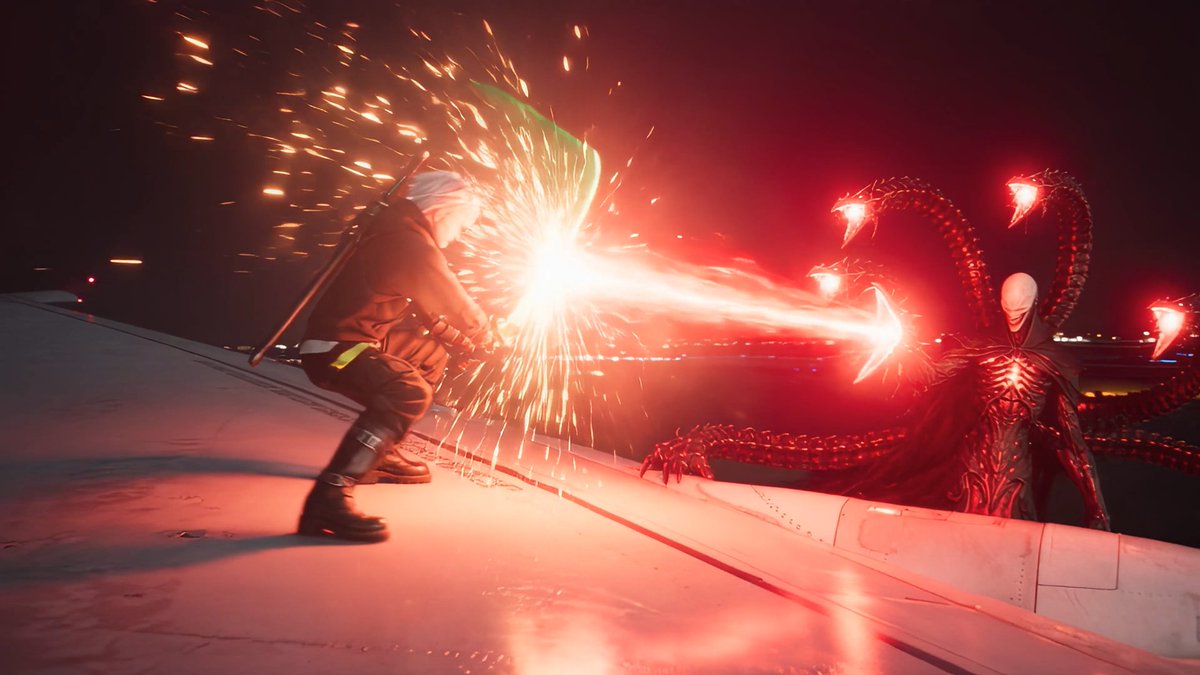
22-23s — Tight three-quarter tracking along the wing: the boss releases its red corruption beam. The swordsman catches it on the angled katana and redirects it upward, away from the fuselage. Show the exact red-beam/green-blade contact and an eruption of sparks.

23-24s — Swing into a short lateral arc around the hero as he slides forward under the continuing blast, turns his blade to shed the beam into the sky, and commits to a single powerful diagonal counterstroke. Keep the boss, sword, and outboard engine in the same composition.

24-25s — Wide profile moving with the wing: ONE decisive green slash visibly bisects the boss's mechanical core AND the outboard engine below it. Show actual separation of metal, cables, and engine casing before any fireball. The main wing and fuselage remain intact.

25-26s — Track the cut boss and destroyed engine as they break away below and behind the aircraft. Their exposed mechanical cores flash and detonate together. A gigantic orange fireball expands behind the surviving wing, illuminating the entire runway and the underside of the jet.

26-27s — A low moving camera follows the swordsman jumping from the wing THROUGH the trailing edge of the explosion. His silhouette remains legible against the flames; he descends toward the runway as the aircraft surges clear ahead.

27-28s — Ground-level tracking meets his landing. His boots strike the runway, he absorbs the impact in a short sliding crouch, then rises calmly with the green katana. Hot fragments tumble down behind him. Do not freeze the camera.

28-29s — Push in beside his shoulder as he returns the katana to its ORIGINAL BACK-MOUNTED SCABBARD. At the exact audible final click, the fallen boss's remaining wreckage erupts in one last huge explosion behind him. He does not turn around.

29-30s — Crane backward and upward from the hero to reveal the rescued passenger jet lifting into the night directly above and beyond him. Both main wings are intact, one outer engine is missing, a smoke trail streams from that damaged mounting area, and the other three engines remain running. Frame the calm hero below, the final fireball behind, and the escaping aircraft above in one readable final composition. End at 30 seconds.

SOUND
NO BGM. Detailed synchronized environmental sound and action effects throughout: terminal ventilation, distant indistinct panic, rolling luggage, running footsteps, moving-walkway motors, automatic rifle volleys, empty cartridges, tentacle impacts, armored bodies hitting glass, metallic sword cuts, electrical arcing, mechanical reactor detonations, shattering glass, falling debris, jet engines, runway wind, landing boots, and the final scabbard click.
Use spatially grounded feature-film sound: ceiling-speaker announcements have a narrow-band PA tone and terminal echo; helmet comms are short and radio-filtered; nearby voices remain human and unprocessed. Interior gunfire reverberates through the huge hall, while exterior explosions open into a broad runway sound field. Let the first impact briefly compress the surrounding sound, then restore the chaos without lingering in silence.
Only these short English lines are intelligible, with natural American delivery:
01-04s, overlapping the action: an urgent airport PA voice says, "Emergency evacuation. Follow crew instructions."
03-04s: a PEST squad leader shouts, "Open fire!"
16-17s: a cabin-crew member calls, "Keep moving!"
Keep the PA behind foreground action and the radio command. Other crowd voices remain indistinct. The swordsman does not speak. The daughter's upward look is silent except for a soft breath, with the ongoing airport chaos still audible. No additional lines for the father or daughter. No narration or explanatory voice-over.
Make the sheathing click briefly prominent, then immediately release the final explosion and overhead jet roar.

EXCLUSIONS
No blood, gore, exposed human wounds, biological organs, or graphic human dismemberment. Destroyed creatures reveal machinery and sparks only.
No subtitles, captions, title cards, HUD, reference-sheet text, or added airline branding. Allow only the specified English environmental airport signs and the original PEST uniform markings. No Japanese announcements or Japanese environmental signage.
No duplicated protagonist or boss, changing faces, costume changes, extra swords, floating weapons, detached slash effects, unexplained teleportation, or disappearing civilians.
No full-wing severing, destroyed passenger cabin, midair aircraft explosion, or restored missing engine.
No opening stare-down, static establishing shot, extended posing, prolonged slow motion, random camera shake, exaggerated cartoon reactions, plastic-looking skin, game interface, or explosion that hides the decisive sword contact.