 1/4
1/4
PROMPT RECORD图像记录
小丑钟敲响了胡言乱语!你知道这意味着什么!今天是 JOLLY 的每日提示! 你们都见过那些投币式算命机。它们自 20 年代就出现了。现在你可以让你的 OC 使用一台来窥见自己的时间线! 特别感...
中文说明
小丑钟敲响了胡言乱语!你知道这意味着什么!今天是 JOLLY 的每日提示! 你们都见过那些投币式算命机。它们自 20 年代就出现了。现在你可以让你的 OC 使用一台来窥见自己的时间线! 特别感谢:@Exarchos 、@Paingore 和 @3p0n4r0xx0rs Your Future by Jolly Joebean Prompt Start ------------------ CHARACTER NAME: [insert your character name here or leave blank to have a random name generated] Designate the attached character reference as @Image1. @Image1 = th...
原始 Prompt
The clown clock has struck nonsense! You know what that means! It’s JOLLY’S PROMPT OF THE DAY!
You have all seen those coin operated fortune-teller machines. they have been around since the 20's. well now you can have your OC use one to see their own timeline!
Special Thanks To: @Exarchos , @Paingore , and @3p0n4r0xx0rs

Your Future by Jolly Joebean

Prompt Start
------------------

CHARACTER NAME: [insert your character name here or leave blank to have a random name generated]

Designate the attached character reference as @Image1.

@Image1 = the only character identity and visual-design reference.

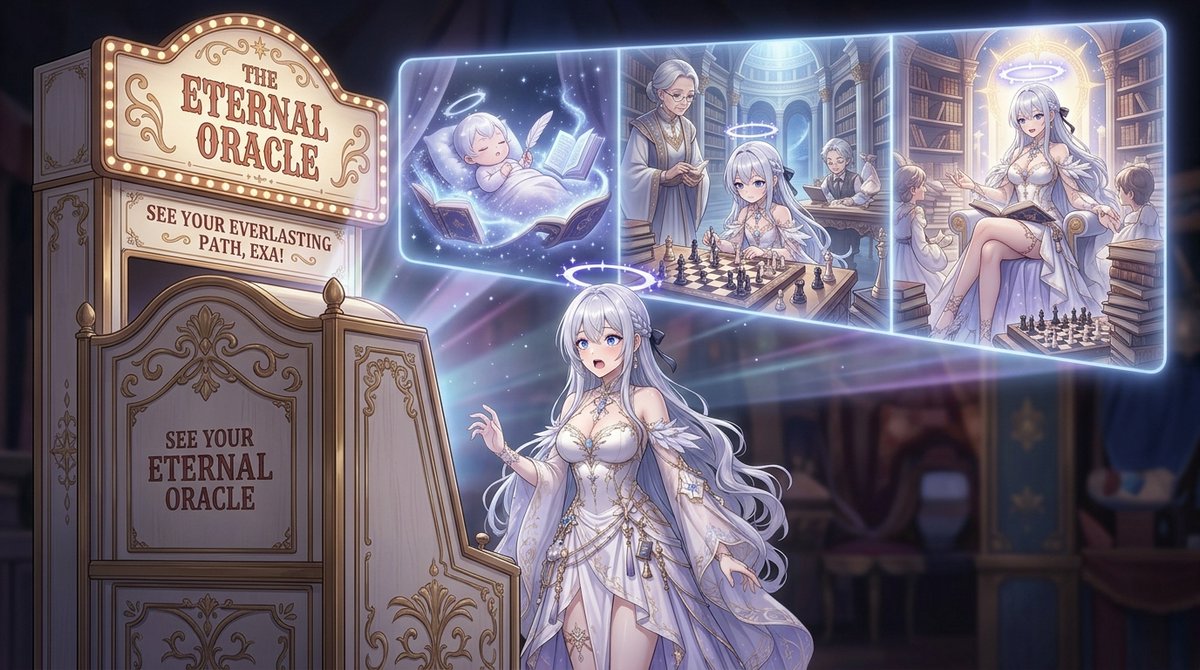
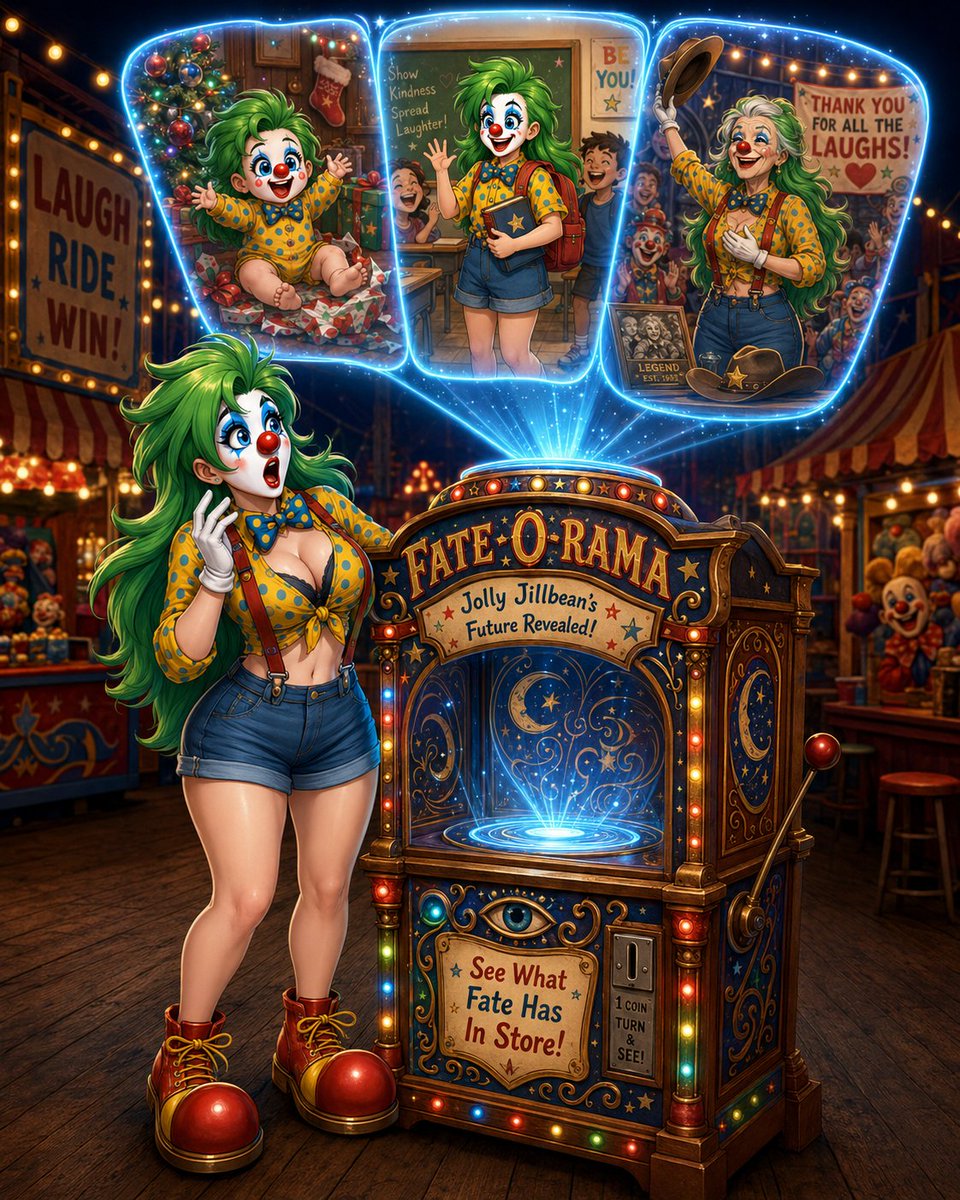
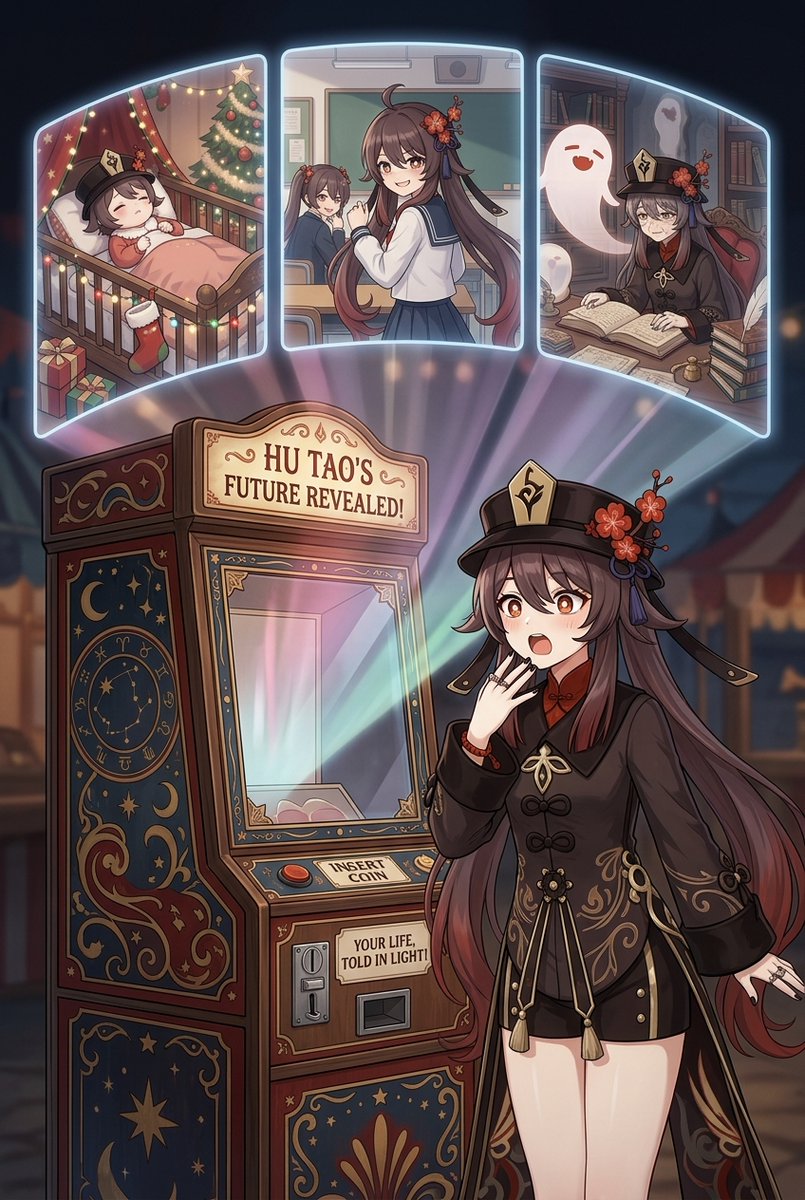
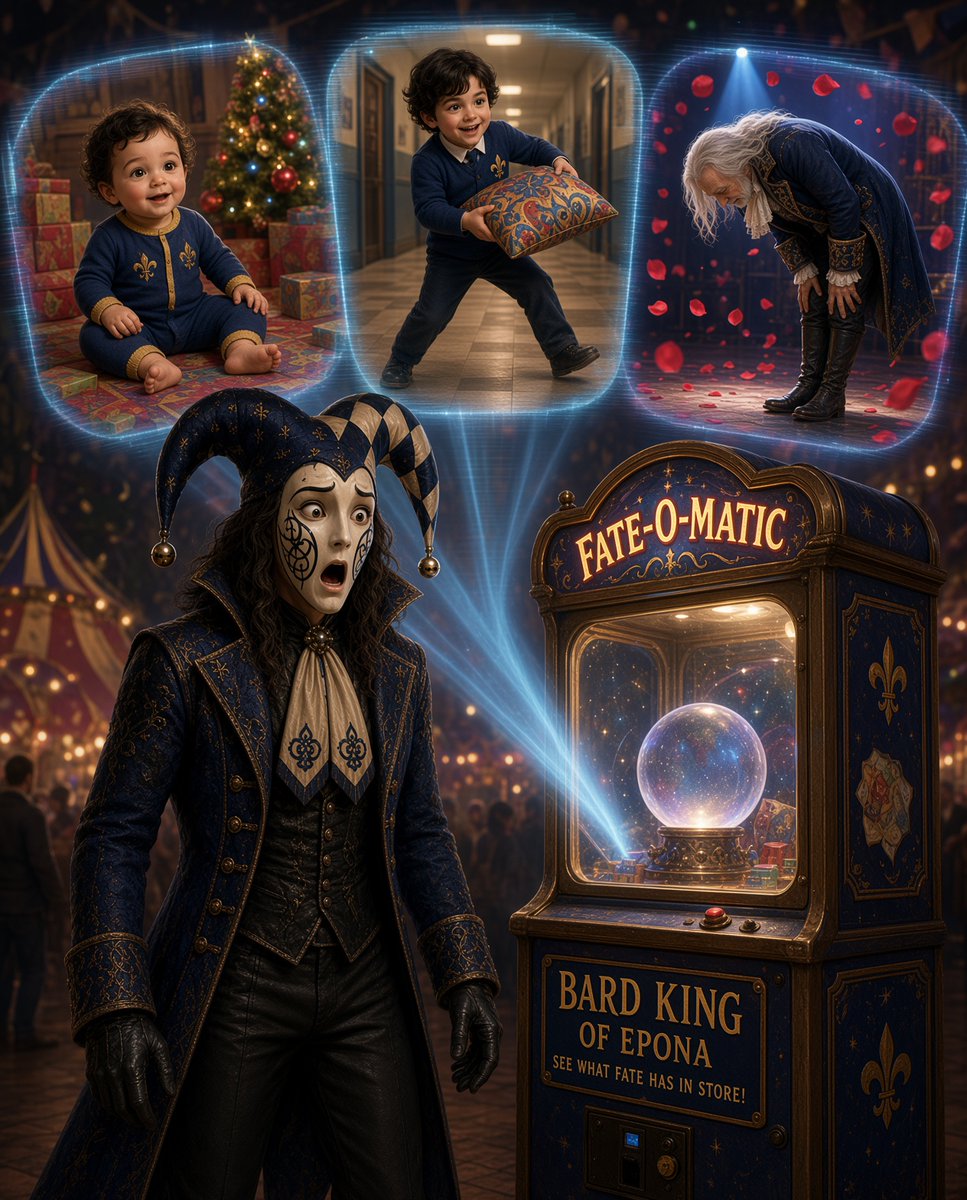
Using the attached reference image, create a single illustrated scene of the character standing in front of a coin-operated fortune-telling arcade machine, reacting in stunned disbelief as the machine projects a large holographic display above their head showing three invented glimpses of their life.

This is a purely fictional, playful concept. The machine is not real, the "future" it shows is entirely AI-invented for entertainment, and nothing in the image should be presented as an actual prediction of any real person's life. This prompt is designed exclusively for original fictional characters (OCs).

This is an image-to-image transformation task — the character's core identity must remain fully recognizable both in their present-day pose and across all three invented life-stage projections.

NAME LOGIC:

- If a CHARACTER NAME is provided above, use it to personalize the machine's display text (see Step 4).
- If left blank, generate a fitting original name for the character based on their visual design and personality cues, then use that invented name in Step 4.

FALLBACK LOGIC:

- If the reference image is not a character (e.g., an object, logo, or landscape), invent an original mascot/avatar consistent with its dominant colors and motifs, and build the rest of the concept around that invented character.
- If the character's species, anatomy, or nature makes a literal human "baby," "school-age," or "elderly" interpretation impossible or nonsensical (robots, non-aging entities, elemental beings, ancient immortals, etc.), reinterpret the three life stages as the closest equivalent developmental or existential stages for that kind of being (see Step 3 special cases).

REFERENCE RULES — HIGHEST PRIORITY

Thoroughly analyze @Image1 and preserve the character's:

Face and facial structure
Hairstyle and hair color (or fur/scale/material color)
Eye shape and eye color
Skin tone or material color
Body type and proportions
Species traits
Signature accessories
Color palette
Outfit motifs
Personality and emotional energy
Original illustrated style

The character must remain unmistakably the same individual in their present-day form and recognizably the same individual (adapted appropriately for age) in all three holographic projections. Do not use characters, costumes, or visual information from previous prompts, generations, or conversations.

|
STEP 1 — DESIGN THE FORTUNE-TELLING MACHINE:

Create a classic coin-operated fortune-telling arcade machine (in the spirit of a carnival or boardwalk fortune-teller cabinet), reimagined with decorative details that echo the OC's color palette and motifs without copying any specific existing branded machine design.

The machine should include:

An ornate wooden or lacquered cabinet with carnival-style trim
A glass-fronted display window
Painted or carved decorative flourishes loosely themed to fortune-telling and mysticism (stars, moons, swirling patterns, mystical eyes, zodiac-style symbols)
A coin slot and a small marquee or header naming the machine (invent a fitting original name, such as "MYSTIC VISIONS" or "FATE-O-MATIC" — do not use real branded fortune-machine names)
Subtle accent lighting in colors drawn from the OC's palette

The machine should feel like a fun, slightly kitschy carnival attraction, not a sinister or high-tech device.

STEP 2 — POSE AND REACTION OF THE CHARACTER:

Show the character standing directly in front of the machine, facing toward the viewer or slightly angled toward the holographic display above their head.

The character's expression and body language should show stunned, slack-jawed shock and disbelief:

Mouth open
Wide eyes
Frozen or slightly recoiling posture
Hands may be raised slightly, gripping the machine, or hanging limp in disbelief

The reaction should be exaggerated enough to be readable and a little comedic, without becoming a full slapstick gag — this should feel like genuine astonishment at seeing one's whole life flash by.

STEP 3 — GENERATE THE THREE HOLOGRAPHIC LIFE-STAGE SCENES:

Above the character's head, render a large, glowing, semi-transparent holographic projection divided into three distinct scenes, arranged side by side or in a gentle arc, connected by soft projector light beaming up from the machine.

SCENE 1 — FIRST CHRISTMAS AS A BABY:
Depict the character as an infant version of themselves during their first Christmas, in a warm, cozy holiday setting (string lights, a decorated tree, wrapping paper, a stocking, soft indoor glow). The baby version must still carry over recognizable traits from @Image1 — coloring, species traits, eye color, and any signature markings — scaled into an infant form.

SCENE 2 — YOUNG SCHOOL-AGE KID:
Depict the character as a young child at school, in a scene that reflects a fitting school setting (classroom, playground, school hallway) with age-appropriate props (backpack, books, simple school attire). The child version should carry over the OC's recognizable coloring, species traits, and a hint of their eventual personality (e.g., a mischievous OC might be shown mid-prank; a studious OC might be shown reading eagerly).

SCENE 3 — ELDERLY VERSION IN A FITTING SCENE:
Depict the character as an elderly version of themselves, placed within a scene that feels specifically fitting to their personality, motifs, world, job, or implied life path, based on cues from @Image1. Analyze the character's design and personality to algorithmically determine what an elderly version of this specific character would plausibly be doing or surrounded by (e.g., a warrior OC might be shown as a respected elder mentor with old battle trophies nearby; a magical OC might be shown as a wise old sage surrounded by spellbooks; a performer OC might be shown taking a final bow to an adoring crowd; a gentle nature-loving OC might be shown tending a garden they've grown for decades). This scene should feel earned and specific, not generic old-age imagery.

SPECIAL CASES FOR NON-STANDARD AGING:

If the character is a species or type of being where literal human-style aging (infant, child, elder) does not make sense — such as robots, constructs, elemental beings, ghosts, deities, or ageless immortals — reinterpret the three stages as the closest equivalent milestones for that kind of being while keeping the same three-scene emotional arc (an early/formative moment, a developing/learning moment, and a late-life/legacy moment). For example, a robot might be shown as a freshly assembled unit, then as a unit learning/training, then as a weathered veteran unit; an immortal being might be shown at their mythic origin, an early adventure, and a distant future legacy moment. Do not force a nonsensical literal baby/school/elderly depiction onto a character where it would break their established nature.

Each of the three scenes must remain thematically connected to the character's established design, palette, and personality from @Image1 — this should feel like a real glimpse of this specific character's life, not a generic stock life-stages montage.

STEP 4 — MACHINE DISPLAY TEXT:

Include a small amount of readable text on the machine itself or along the edge of the holographic projection, styled like carnival fortune-machine signage, such as a short heading using the character's name (e.g., "[CHARACTER NAME]'S FUTURE REVEALED!") and/or a brief carnival-style phrase (e.g., "SEE WHAT FATE HAS IN STORE!", "YOUR LIFE, TOLD IN LIGHT!").

Keep text minimal, legible, correctly spelled, and styled with a fun vintage-carnival typographic flourish. Do not overload the image with dense text or paragraphs.

STEP 5 — COMPOSITION AND LIGHTING:

Use a vertical or square composition with the character and machine grounded in the lower portion of the frame and the three holographic scenes glowing prominently above their head.

The holographic scenes should:

Be clearly separated from one another (light-beam dividers, soft glowing borders, or distinct floating panels)
Share a consistent semi-transparent, glowing, light-projected look distinct from the solid, fully rendered character and machine
Read in a clear left-to-right or chronological arc (baby → child → elder)

Light from the hologram should cast a soft colored glow across the character's face and the surrounding setting, reinforcing that this light is the source of the character's shocked expression.

Keep the setting around the machine simple and atmospheric — a dim carnival midway, boardwalk arcade, or softly lit room — so the machine and hologram remain the clear focal point.

STEP 6 — RENDERING STYLE:

Render the whole piece in a polished, semi-realistic illustrated style with painterly lighting, rich color, and a slightly whimsical, storybook-adjacent quality appropriate to a magical carnival attraction. Preserve @Image1's original illustrated style/medium where possible (e.g., if @Image1 is anime-style, keep the character and hologram scenes anime-inspired; if painterly, keep it painterly).

QUALITY TARGET:

High-quality illustration with a clearly recognizable character in their present-day form, three distinct and thematically fitting holographic life-stage scenes above their head, a charming original fortune-machine design, a readable and expressive shocked reaction, legible carnival-style signage text, and cohesive lighting tying the whole scene together.

DO NOT:

Do not change the character's identity.
Do not change the character's eye color, species traits, or signature accessories.
Do not use information from previous characters or prompts.
Do not present this as a real fortune-telling or prediction of any real person — this is a fictional OC concept only.
Do not force a literal baby/child/elderly depiction on a character whose nature makes that nonsensical — use the special-case reinterpretation instead.
Do not make the three holographic scenes generic or interchangeable with any other character's life stages.
Do not make the elderly scene random — it must be derived from the character's actual personality, motifs, and implied world.
Do not cover the character's face with the hologram or machine.
Do not use real branded fortune-machine names, logos, or copyrighted carnival character designs.
Do not make the character's reaction violent, distressed, or frightened — it should read as stunned amazement, not fear.
Do not include real dates, real years, or real-world identifying information.
Do not overload the image with dense or unreadable text.
Do not create malformed hands, extra limbs, distorted anatomy, or unreadable text.
Do not make the image blurry, muddy, or inconsistent in style between the character, machine, and holographic scenes.

The finished image should feel like a warm, slightly comedic, wonder-filled moment — an original character stumbling upon a magical carnival machine and staring in total disbelief as it plays out three loving, specific glimpses of a life that was always meant to be theirs.

---
Prompt End